Что лучше Солана или Бнб?
Хотя BSC отличается более высокой степенью использования и рыночной капитализацией, а также процветающей отраслью DeFi, позволяет создавать binance smart chain metamask, его сеть жертвует некоторой степенью децентрализации для достижения повышенной масштабируемости.
Какая сеть у Соланы?
Solana – это одна из лучших децентрализованных сетей для создания NFT-решений, DeFi-проектов и смарт-контрактов. Такое преимущество достигается за счет использования системы LLVM и языка программирования Rust.
Что такое Multi Chain switch?
Multichain — это протокол кроссчейн-маршрутизатора (CRP) с открытым исходным кодом, который позволяет пользователям переводить токены из разных блокчейнов.
Какая сеть у Соланы?
Solana – это одна из лучших децентрализованных сетей для создания NFT-решений, DeFi-проектов и смарт-контрактов. Такое преимущество достигается за счет использования системы LLVM и языка программирования Rust.
Чем хороша Солана?
Solana утверждает, что его блокчейн способен поддерживать более 50 000 транзакций в секунду (TPS) при пиковой нагрузке, что делает его, пожалуй, самым быстрым блокчейном работающим в настоящее время. Для сравнения: это почти в 1 000 раз быстрее Bitcoin (
5-7 TPS) и более чем в 3 000 раз быстрее Ethereum (
Почему Солана падает в цене?
Какая сеть для BNB?
BNB Chain является результатом объединения в одну децентрализованную сеть двух продуктов Binance: Binance Smart Chain (BSC). Это блокчейн, совместимый с Ethereum. Его ценность заключалась в создании и активном использовании смарт-контрактов.
Какую сеть выбрать в Binance?
Что такое Мультичейн?
Мультичейн-сети позволяют проектам работать на двух или более блокчейнах и служат в качестве слоя масштабирования других блокчейнов. В этой статье попробуем разобраться, превзойдут ли в секторе GameFi мультичейн-сети или существующие кроссчейн решения, и почему последние сегодня имеют особую востребованность.
Какой Блокчейн у Солана?
Solana — это блокчейн третьего поколения, который поддерживает множество решений DeFi, включая разработку децентрализованных приложений (DApps) и смарт-контрактов.
Как подключить сеть Солана в Метамаск?
Как добавить другую сеть в Метамаск разворачиваем кошелек (это для удобства, можно пропустить); нажимаем на выпадающий список сетей и выбираем добавить сеть; вводим параметры сети и сохраняем ее.
Можно ли Майнить Sol?
Как уже было сказано выше, SOL нельзя майнить, зато можно зарабатывать на стейкинге, что намного проще, чем майнинг.
Почему Солана перегружена?
Сеть Solana (SOL) перегружена из-за роста количества сложных транзакций, сокративших ее производительность до нескольких тысяч транзакций в секунду и вызвавших сбой некоторых пользовательских транзакций.
Какая сеть у Соланы?
Solana – это одна из лучших децентрализованных сетей для создания NFT-решений, DeFi-проектов и смарт-контрактов. Такое преимущество достигается за счет использования системы LLVM и языка программирования Rust.
Можно ли Майнить Солана?
В отличие от Ethereum, в котором используется алгоритм консенсуса Proof of Work, в блокчейне Solana применяется другой подход — Proof of History. Это означает, что Solana не нужно майнить, как другие криптовалюты.
Что такое Солана простыми словами?
Что такое Solana простыми словами? Это общедоступный блокчейн и прямой конкурент Ethereum. Solana отличается тем, что использует уникальный алгоритм консенсуса, известный как Proof of History (PoH). Блокчейн также имеет собственную криптовалюту, которая также называется Solana (SOL).
Чем Солана лучше эфира?
Ethereum — более безопасный и наиболее децентрализованный вариант из двух, а Solana — более быстрая и экономичная сеть. Солана быстрая. Сеть может выполнять блок каждые 400 миллисекунд и записывать 65 000 транзакций в секунду. Это один из самых быстрых блокчейнов просто из-за этих качеств.
Не все из монет переживут «криптоапокалипсис», однако именно эти виртуальные деньги будут расти в цене, а инвесторы получат прибыль. К монетам, в которые следует инвестировать, эксперт относит: Биткойн (BTC), Ethereum (ETH) и Decentraland (MANA), Binance Coin, Solana.
Сколько может стоить Solana?
Текущая цена SOL Объем торгов за 24 часа: ₽ 50.29B RUB. Цена SOL к RUB обновляется в режиме реального времени. Solana: -2.45% за последние 24 часа.
Какая эмиссия у Соланы?
Что такое криптовалюта Solana На нем основан принцип работы новой версии блокчейна эфира — Ethereum 2.0. Эмиссия SOL конечна, как и в случае с биткоином. Она ограничена 489 млн монет.
Зачем нужны BNB?
Binance Coin (BNB) имеет несколько вариантов использования: Для уплаты взносов и комиссий в платформе Binance. BNB является одной из ключевых криптовалют для криптотрейдинга. Для оплаты товаров и услуг через широкий спектр приложений, таких как DApps и игры на базе блокчейна Binance.
Где можно хранить BNB?
Trust Wallet – официальный цифровой кошелек Binance. В нем можно безопасно хранить BNB, а также управлять приватными ключами доступа к активам.
На каком Блокчейне работает BNB?
Как вывести деньги с Binance сейчас?
Переходим на Binance. Открываем пункт «Кошелек», выбираем «Фиат и спот». Нажимаем «Вывод». Выбираем «Вывод криптовалюты».
Podobne clanky
Были ли наши ответы полезны?
Большое спасибо за ваш отзыв!
У вас есть еще вопросы?Отправить
Kryptoměna je typ digitální měny či elektronických peněz, což je novodobý druh měny/peněz. Podle vyjádření Generálního finančního ředitelství a podle rozhodnutí soudu se však nejedná o měnu či peníze, ale o nehmotnou movitou věc. Tyto „peníze“ jsou tvořeny elektronicky.Jak začít s Kryptoměnami? Investování do kryptoměn je snadné. Stačí e-mailový a bankovní účet, vybrat si důvěryhodnou kryptopeněže.
Danit je třeba až v momentě směny nebo prodeje. Od základu daně lze odečíst výdaje k nutné k vytěžení kryptoměn (kupní cena grafické karty, elektřina použitá pro těžbu…) nebo lze využít paušál ve výši 60 procent z takto dosažených příjmů.Musím tedy platit daň z kryptoměn za 2021? Ano, musíš platit vždy daň tehdy, pokud jsi v zisku nebo realizuješ zisk. Nedoporučuje se ani moc nakupovat kryptoměny.
Dividendy vyplácené akciovými společnostmi, které jsou zahraničnými daňovými rezidenty, podléhají dani v ČR ve výši 15 %. Je tedy povinnost akcionáře tento příjem přiznat v daňovém přiznání. Příjem z dividend patří do kapitálového majetku a v daňovém přiznání se uvádí na řádek 38.Příjmy z dividend jsou zdaněné u zdroje srážkovou daní, kterou odvádí společnost vyplácející dividendy, případně ten kd.
Příjmy z držby a prodeje cenných papírů jsou součástí výsledku hospodaření právnických osob. Následně se pak příjmy osvobozené od daně, příjmy zdaněné srážkovou daní a příjmy zahrnované do samostatného základu daně vylučují z obecného základu daně z příjmů právnických osob.Jak zdanit příjmy z akcií? Sazba daně ze zisku z akcií a kam v přiznání patří? Pro poplatníky, kteří nezahrnuli akcie do svého.
Jak se odečítají dary z dani? Kdy musím danit dar? Jak se vyhnout darovací dani? Daň z příjmů dle § 10 odst. 3c Zákona o dani z příjmu se neodvádí z daru: od příbuzného v linii přímé (např. z otce na syna, vnuka či opačně) a v linii vedlejší, pokud jde o sourozence, strýce, tetu, synovce nebo neteř, manžela, manžela dítěte, dítě manžela, rodiče manžela nebo manžela rodičů. Kdy musím danit dar.
Zisk je definován jako kladný rozdíl výnosů a nákladů, které spolu věcně a časově souvisí a jsou v souladu s platnou legislativou. Pokud použijeme všechny náklady a výnosy společnosti, které byly vynaloženy v daném účetním období, pak je výsledkem zisk po zdanění neboli čistý zisk.Čistý zisk po zdanění (individuální) = (hrubý příjem) – (+ Srážky Credit + daní) Čistý zisk po zdanění (Business) = (c.
Disponibilní zisk je tzv. výsledek hospodaření po zdanění. Disponibilní zisk se vypočítá tak, že se od hrubého účetního zisku odečte daň z příjmu.Jak se počítá zisk po zdanění? Pokud od účetního zisku 150 000 Kč odečteme daň 38 000 Kč, částka 112 000 Kč představuje tzv. disponibilní zisk. Ve výkazu zisku a ztráty vykazujeme částku 112 000 Kč v řádku „Výsledek hospodaření po zdanění“ a v řádku „Výs.
V záhlaví je nutné vyplnit celý název finančního úřadu, územní pracoviště, DIČ (pokud vám bylo přiděleno), rodné číslo a kód DAP. Pak následují jednotlivé oddíly, kde se vyplňují základní údaje o poplatníkovi a veškeré jeho příjmy, ale zároveň je zde také možné uplatnit tzv. Protože má Vlaďka příjmy jako OSVČ, vyplní nejdříve Přílohu č. 1, odkud se jí údaje přetáhnou dál do formuláře. Nejprve tedy.
What Is Multi-Chain?
Since its beginnings as a single network called Bitcoin in 2009, the blockchain industry has grown in leaps and bounds, with pioneers continuously pushing forward the capabilities of blockchain technology. An early example of this was Ethereum, which was the first blockchain to expand the concept of blockchain technology past transaction verification to a full-fledged decentralized computing platform. This resulted in the birth of DeFi , NFTs , and other verticals, which represent the lion’s share of user-facing applications that exist today.
This innovation was not limited to Bitcoin and Ethereum—hundreds of blockchains have since been created to attempt to solve the blockchain scalability trilemma and provide developers with new technology to build decentralized applications. With these blockchains, the era of multi-chain began.
What Is Multi-Chain?
At the highest level, the term “multi-chain” simply refers to the ecosystem of hundreds of blockchains that exist today. However, the term is used most frequently to describe applications that launch on multiple blockchains, widely known as “multi-chain applications.”
How Does Multi-Chain Work?
Multi-chain is the result of blockchain fragmentation. Because each blockchain is effectively an island with little to no connectivity with other blockchains or the outside world , an application on one blockchain can’t be accessed by a user on another blockchain.
In a multi-chain application, developers configure a separate and isolated instance of their smart contracts for each different blockchain. This is because the immediate goal for any application after its launch is to garner more users, and so multi-chain expansion is the natural next step.

In a multi-chain application, there are separate and isolated smart contracts on each blockchain.
Multi-chain applications are needed because decentralized applications (dApps) that exist solely on one blockchain may be missing out on millions of users on another blockchain. A user who’s already onboarded onto a different blockchain must take many steps to access that application—for example, adding a new network or downloading a new wallet, bridging funds from one blockchain to another, and then acquiring the native gas token to transact. Multi-chain expansions solve this problem by meeting users on the blockchain environments they’re already familiar with.
Problems With Multi-Chain
Multi-chain applications are a solution for developers to access the widest possible net of users, but they come with their own set of limitations.
Technical Burden
The effort to build, maintain, and update a multi-chain application is immense, especially because new blockchains are constantly emerging. For each new blockchain, developers must change their code to fit the blockchain’s specific technical requirements, ensure the code is well-written and secure, and maintain each instance separately.
This is why multi-chain applications often stay within a certain ecosystem, reducing the technical complexity of launching a new application. Applications on Ethereum are far more likely to expand to EVM-compatible chains, for example.
Isolated Liquidity
Increasing liquidity results in a self-reinforcing cycle. A decentralized exchange (DEX) with the highest liquidity can offer the lowest slippage for transactions, the most expansive liquidity rails, and the highest yields to liquidity providers. It is one of the largest competitive differentiators between DeFi protocols.
The lack of connectivity between individual instances of a multi-chain application is a large problem for decentralized finance (DeFi) applications specifically because it fragments this liquidity. In the current paradigm, multi-chain DeFi applications have separate liquidity pools for each blockchain, fragmenting the liquidity available to the end user.

Synthetix leverages Chainlink CCIP to unlock cross-chain collateral for users, enabling universal liquidity pools.
Multi-Chain vs. Cross-Chain
The difference between cross-chain and multi-chain applications is nuanced. While cross-chain and multi-chain applications differ significantly today, it’s possible that the two terms will become synonymous in the future.
Today, the largest difference is in the technical implementation of these applications. Multi-chain applications have separate and isolated smart contracts on each blockchain. In contrast, cross-chain applications have a unified set of smart contracts that communicate seamlessly across chains, unlocking a best-of-both-worlds approach given the application has access to a secure cross-chain messaging protocol .
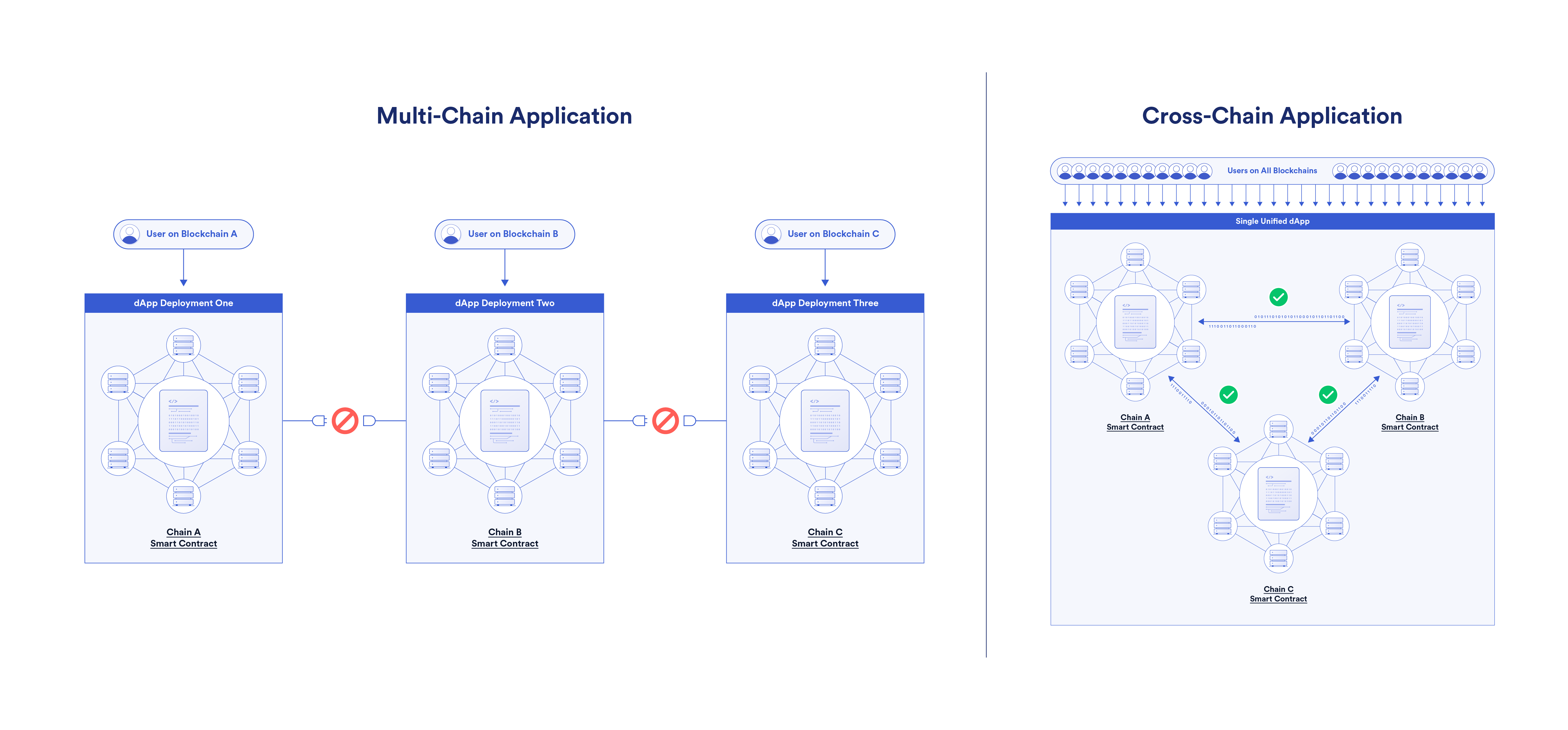
Cross-chain applications help abstract away the technical complexities of blockchains for both user and developer.
Cross-chain applications unlock modularity in application design: Instead of building redundant smart contracts for each chain, developers can run separate different parts of their application on the chains they’re best suited for. A Web3 game can process game transactions on a high-throughput, low-cost chain that then mints an NFT for the player on a chain purpose-built for security. A DeFi protocol can unify liquidity by enabling users to access liquidity across any chain.
With cross-chain applications, users don’t have to care about which blockchain they’re on. They only need to know how to navigate the application—a vision that started with multi-chain, but is being expanded, and fully realized, by cross-chain.
Why Do We Need Multi-Chain?
The proliferation of a multi-chain ecosystem is a healthy evolution for Web3, where different blockchains have competitive differentiators that make them the best fit for a particular type of application. It breeds competition, which then inspires innovation.
Multi-chain is also a necessity for users in order for them to access the widest range of applications possible. In any user-facing application, the burden of effort lies on the developers. Users deserve a frictionless experience, and that’s what multi-chain—and cross-chain—applications offer. They meet users on the blockchain environments they’re already comfortable with.
How Chainlink Empowers a Multi-Chain Ecosystem
Cross-chain is the natural next step for multi-chain. It unlocks elegant application design, enables specialized division of labor between blockchains, and abstracts away technical complexities from both user and developer.
That said, the cross-chain connectivity problem has been difficult to solve, to say the least. Historically, cross-chain bridges and messaging protocols have suffered from poor security, resulting in $ 2.5B+ in total value being hacked from bridges in 2022. But the demand for cross-chain—and the potential of what can be built with access to a secure cross-chain messaging protocol—has remained steady, evidenced by $7B+ in monthly bridge volume.

Though cross-chain bridges are an integral part of Web3, they’ve historically suffered from poor security.
That’s where Chainlink Cross-Chain Interoperability Protocol (CCIP) steps in. As the industry-leading cross-chain messaging solution, CCIP leverages the same high-quality Chainlink node operators that have securely enabled more than $8 trillion in value for DeFi protocols. With an existing platform of proven Web3 services for dApps to access price data feeds, verifiable randomness, smart contract automation, and more, Chainlink has helped power over 1,800 projects in the Web3 ecosystem to date.

Chainlink CCIP is the most secure cross-chain messaging protocol in Web3.
Chainlink CCIP introduces a variety of unique features that help ensure dApps can securely and reliably build cross-chain applications, such as:
- Simplified Token Transfers: CCIP has a plug-and-play solution that handles the complexity of burning and minting or locking and minting tokens across chains.
- Rate Limits: CCIP supports customizable rate limits on the amount of tokens able to be transferred between blockchains within a given time period.
- Smart Execution: CCIP utilizes a gas-locked fee payment mechanism to help ensure the reliable execution of cross-chain transactions regardless of destination chain gas spikes.
- Risk Management Network: The Risk Management Network continually monitors and validates the behavior of the primary CCIP network, providing an additional layer of security by independently verifying cross-chain operations.
For full details on CCIP’s unique differentiators and technical implementation, read this blog.
Simply put, CCIP provides developers with the full functionality they need to confidently build cross-chain applications. In a vertical where security is not just a nice to have but a necessity, Chainlink’s ability to provide secure Web3 services is paramount for long-term success when building seamless decentralized applications.
A New Era of Multi-Chain Is Beginning
One key goal of all decentralized applications is to eliminate the barriers that cause users and developers alike to make a clear distinction between Web2 and Web3. It’s not difficult to imagine a universe where a user doesn’t know which blockchain they’re using, or whether an app uses blockchain technology or not. But in order to make this a reality, developers need better tools to build seamless applications that can abstract away all the technical complexities that exist today.
Multi-Chain
Multi-chain is a foundational term that promotes blockchain interoperability and decentralization.
What Is Multi-Chain?
So What Is Multi-Chain?
Multi-Chain vs Single-Chain
Multi-chain technology creates a network for blockchains to communicate simultaneously without needing to move their assets from one network to another.
What’s the Difference Between Multi-Chain and Cross-Chain?
How Does a Multi-Chain Protocol Work?
The Importance of Multi-Chain
Kadan Stadelmann is a blockchain developer, operations security expert, and Chief Technology Officer of Komodo, an open-source technology provider that offers all-in-one blockchain solutions for developers and businesses. Komodo works closely with organizations that want to launch their own custom decentralized exchanges, DeFi platforms, and independent blockchains. Its flagship technology and end-user application is AtomicDEX — a mobile and web-compatible non-custodial multi-coin wallet and atomic swap-powered DEX rolled into one dApp.
Kadan strongly identifies with Komodo’s open-source vision and ideology. His dedication to the Komodo project is founded on an unwavering desire to make the world a better place. In addition to cryptography, blockchain technology, and development, Kadan is interested in literature, mathematics, astrophysics, and traveling.
Multi-chain VS cross-chain dApps: how do they differ and which one to choose?
Have you ever wondered what’s the difference between multi-chain and cross-chain dApps?
As a Chief Technical Officer of Arctic Wallet, I often get asked about the differences between multi-chain and cross-chain dApps. For anyone interested in blockchain interoperability, this topic is essential ��
Multi-chain dApps are designed to run on multiple blockchains at the same time. This means that a single dApp can be accessed by users on different blockchains, without needing any cross-chain functionality. Multi-chain dApps are typically used to provide users with more options when it comes to choosing which blockchain to use for a particular application.
Let’s try to dig deeper into that subject ��
So, a multi-chain dApp is a smart contract deployed on one chain with similar smart contracts deployed on other networks⤵
E.g. Uniswap is a smart contract deployed on the Ethereum blockchain that allows users to swap one ERC-20 token for another. However, Uniswap has also been deployed on other blockchains, such as the Binance Smart Chain and the Polygon network, with similar smart contracts deployed on those networks. This means that users can access a Uniswap on multiple blockchains, giving them more options when it comes to trading ERC-20 tokens.
Sounds great but there is a problem — the same code deployed on several networks does not make it a unified & harmonious dApp ❌
Due to lack of interoperability between deployments each contract manages its own internal state on different blockchain environments⤵
This makes development of multi-chain dApps not only expensive but also very risky ��
An example of this issue can be seen in the development of decentralized applications that use non-fungible tokens (NFTs). NFTs are often created and traded on the Ethereum blockchain, but there are many other blockchains that also support NFTs.
If a developer wants to create a multi-chain dApp that allows users to create and trade NFTs on multiple blockchains, they would need to deploy separate smart contracts for each blockchain. Each smart contract would need to manage its own internal state in its respective blockchain environment.
This creates a number of challenges for developers. Firstly, deploying smart contracts on multiple blockchains can be expensive, as each deployment requires gas fees and other costs. Additionally, managing multiple smart contracts on different blockchains can be complex and time-consuming.
Furthermore, since each smart contract is managing its own internal state, there is a risk that data can become inconsistent between different blockchain environments. This can result in errors, lost data, and other issues that can make the development of multi-chain dApps very risky.
Cross-chain dApps, on the other hand, are designed to facilitate communication and interaction between different blockchains. Cross-chain dApps typically use specialized protocols or middleware to enable communication between different blockchains. This allows users to transfer assets, execute smart contracts, and access applications across different blockchains.
Unlike multi-chain dApps, cross-chain dApps allow for the transfer of data, tokens, and commands between on-chain environments ⤵
E.g. Chainlink is a cross-chain dApp that provides decentralized oracle services, allowing smart contracts to access real-world data from multiple sources. It operates across multiple blockchains, including Ethereum, Binance Smart Chain, and Polkadot, and allows for the transfer of data and commands between these different environments. Chainlink also enables the transfer of tokens between blockchains, which is necessary for the execution of certain smart contracts. Its cross-chain functionality has made it a popular solution for various industries, including finance, insurance, and supply chain management.
Another example here could be a decentralized lending platform ⤵
A cross-chain lending platform could allow users to lend and borrow tokens across multiple blockchains. Through the use of specialized protocols and middleware, the lending platform would be able to connect to multiple blockchains and enable the transfer of tokens and data between them.
For example, a user could borrow tokens on the Ethereum blockchain and use them to provide liquidity on a different blockchain, such as Binance Smart Chain. The lending platform would facilitate the cross-chain transfer of the borrowed tokens, ensuring that the user can access the liquidity they need to participate in DeFi applications on different blockchains.
Overall, cross-chain lending platforms have the potential to provide users with greater access to liquidity and investment opportunities across different blockchains, while also promoting greater interoperability and collaboration between different blockchain ecosystems ��
Think of several separate smart contracts on different networks that can communicate with each other to create a single unified dApp ����
Cross-chain dApps not only share liquidity across networks but also their business logic, and they operate as a single entity that spans multiple networks⤵
Let’s say you want to buy a cup of coffee using cryptocurrency. You have Bitcoin on the Bitcoin blockchain and Ether on the Ethereum blockchain. However, the coffee shop only accepts payments in Ether ��
With a cross-chain dApp, you could easily exchange your Bitcoin for Ether and make the payment without having to worry about transferring the Bitcoin to an exchange, selling it for Ether, and then sending the Ether to the coffee shop.
The cross-chain dApp would enable you to swap your Bitcoin for Ether directly within the app, using shared liquidity and business logic across different blockchains. This would allow you to make the payment in Ether, even though your funds were originally held on a different blockchain ����
But how to choose which type of dApp to use?
Cross-chain dApp
Suppose you have some cryptocurrency on the Bitcoin blockchain, but you want to use it to make a purchase that can only be made with Ethereum. In this case, you could use a cross-chain dApp to swap your Bitcoin for Ethereum directly within the app, rather than having to move your Bitcoin to an exchange, sell it for Ethereum, and then send the Ethereum to your wallet. This would save you time, fees, and hassle, and would allow you to use your funds on the network where they are needed.
Multi-chain dApp
Suppose you have a decentralized application that you use frequently, but you’re concerned about the high fees or slow transaction times on the blockchain it’s currently deployed on. In this case, you could look for a version of the same application that is deployed on a different blockchain with better fees or faster transaction times. This would allow you to continue using the same application logic, but with better performance and lower costs.
Overall, the choice between cross-chain and multi-chain dApps will depend on the specific needs and preferences of the user, as well as the availability of different versions of the same application on different blockchains. Cross-chain dApps are best for users who need to transfer assets between blockchains or access liquidity across multiple networks, while multi-chain dApps are best for users who want to access the same application logic on different blockchains to take advantage of specific features or avoid high fees.
#dapps #crosschain #multichain #blockchain #defi #smartcontracts #nft