A Complete Guide to Ethereum's Rinkeby Testnet
The Rinkeby testnet was deprecated by the Ethereum Foundation on October 5th, 2022. On October 5th, 2022, Alchemy's Rinkeby faucet was also deprecated. The Rinkeby testnet will be read-only for the foreseeable future and will be sunset in Summer 2023. Therefore, we recommend using Sepolia testnet to test your dApps, as Alchemy has full Sepolia support and a free Sepolia faucet.
What is the Rinkeby testnet?
The Rinkeby testnet was an Ethereum testnet used by developers to test decentralized applications before deploying them to the Ethereum mainnet. The network was a fork of the Ethereum mainnet that was run by pre-authorized nodes, preventing spam attacks and increasing performance.
Developers used Rinkeby Faucet to get free testnet ETH to test their smart contracts without the risk of losing tangible financial assets. Because it was a testnet, the currency was worthless. Users couldn't mine ETH within the Rinkeby testnet; they only requested it. Authorized nodes were the only ones that created new blocks, meaning no other nodes were awarded mining rewards.
The Rinkeby testnet supported the following node clients: Geth, Besu, Nethermind, and OpenEthereum.
This article will explain the Rinkeby testnet, its main uses, the Proof-of-Authority (PoA) consensus mechanism, and why it was deprecated.
When did Rinkeby launch?
The Ethereum team launched the Rinkeby testnet in 2017 using a modified proof of authority consensus model and was deprecated in favor of the Goerli testnet, another popular testnet that used the proof of authority consensus mechanism.
Rinkeby used proof of authority (PoA), a modified form of Proof of Stake (PoS). Instead of staking with something that has monetary value, a validator’s identity performs the staking to provide high performance while also giving fault tolerance.
How big was the Rinkeby testnet?
There were about 11,000,000 blocks on the network, and as of 2021, Rinkeby had about 50 million transactions. While in use, the Rinkeby testnet had 46 active nodes, and the block time for the Rinkeby testnet was about 15 seconds. The max limit a block could be filled up with transactions was about 41,000.
The Block gas limit for the Rinkeby testnet was about 30 million gas. The gas limit refers to the max price a cryptocurrency pays when sending a transaction or performing a smart contract function in the Ethereum blockchain.
Fees are calculated in gas units, and the gas limit defines the maximum value that the transaction or function can "charge" or take from the user. With the gas price at about 1,000 gwei and 0.1 h/s average network hash rate, it provided 100% uptime with 30-80 ms page latency.
Why did developers use Rinkeby over other testnets?
Developers chose Rinkeby over other testnets due to its faster block time. Ropsten had a block time of about 30 seconds, but Rinkeby cut that time in half.
The chain data size for Rinkeby was only about 6GB, which meant running an Ethereum node for Rinkeby wouldn’t require much data size compared to other testnets.
Overall, Rinkeby was known to be more reliable and faster than other testnets.
What were some disadvantages of using Rinkeby?
One of the disadvantages of using Rinkeby was that its proof of authority blockchain consensus model didn't fully simulate the production environment. This was different from the Ropsten testnet, where miners on the network had a financial incentive to maintain the testnet itself. The Ropsten testnet used a PoW consensus mechanism, which made it identical to the Ethereum PoW consensus mechanism.
Unlike the Kovan testnet, Rinkeby's testnet supported Geth software, not Parity.
How did developers use the Rinkeby testnet?
The primary use case for using the Rinkeby testnet was for developers to test their applications in a controlled testing environment that functioned like Mainnet Ethereum without taking the financial risk of executing smart contracts, iterating application features, and performing functionality.
Rinkeby was famously used by well-known companies such as OpenSea, Manifold Studios, and Rarible, which deployed their NFT marketplaces on Rinkeby before deploying on the mainnet.
Developers also used the testnet as an educational tool. Often, developers make several mistakes along their journey, and using a testnet enables them to understand better how to use the mainnet in the future.
Finally, developers used Rinkeby to test upgrades to the underlying platforms. This is essential to create better developer tools for the Web3 ecosystem and to create more libraries, better documentation, and essential feedback overall.
All these use cases relate to creating a safe space for developers to thrive. Without testnets like Rinkeby, developers would have to bear the consequences of potentially losing real-world assets, and they would have to be more careful interacting with their smart contracts.
How to Get Testnet ETH
Since the deprecation of the Rinkeby testnet, developers and Ethereum enthusiasts have transitioned to using the Sepolia testnet as an alternative testnet for testing Ethereum protocol upgrades and smart contracts. Here's a step-by-step guide on obtaining Sepolia ETH from a Sepolia testnet faucet that allows anyone to send a small amount of fake ETH to their wallet.
- Head to Alchemy's free Sepolia Faucet
- Sign in to your Alchemy account
- Enter your wallet address or ENS name
- Click "Send Me ETH"

A popup will display ‘Transaction sent’ with the amount of Sepolia ETH deposited to your wallet.
Next, you can check your Ethereum wallet to confirm you received the SepoliaETH.

With your Sepolia ETH, you can now run smart contracts on the Sepolia testnet.
To view the date and time, transaction fee, gas burnt, and other transaction details, you can look up your transaction hash on the Sepolia Etherscan.

What are the best Rinkeby testnet tools?
While the Rinkeby testnet was in use, it worked best with other blockchain developer tools to ensure developers had a great experience creating decentralized apps using a modern web3 tech stack. Web3 developers should consider the depth and breadth of available developer tooling, such as:
Popular Web3 Libraries
Two of the most used Web3 native libraries include ethers.js and web3.js. These libraries natively support remote procedure calls (RPC) to blockchain nodes hosted on the blockchain interaction layer. This enables seamless integration into a developer’s Web3 tech stack and reading and writing data to the blockchain.
Alchemy has another Web3 library. The alchemy-web3.js library is a drop-in replacement for web3.js and is built and configured to work seamlessly with Alchemy and provide multiple advantages, such as automatic retries and robust WebSocket support.
Popular Web3 Development Environments
Fortunately, EVM-compatible chains benefit from years of Ethereum development and have many battle-hardened options for development environments.
Hardhat, Truffle, and Brownie are all great options for development environments in Web3. These developer environments allow developers to compile, test, deploy, and debug Ethereum software.
In addition, they come with more tooling and easily customizable local blockchain development environments.
When it comes to decentralized storage, IPFS, Filebase, and Arweave serve as great options. Decentralized storage fills the gap for expensive and inefficient frontend content like images, videos, and GIFs.

Alchemy Tools
Development platforms like Alchemy provide an extensive suite of tools for testing and fixing bugs: Supernode, Build, Monitor, and Notify make this process much more convenient.
Now that the Rinkeby testnet is deprecated, developers can use Alchemy’s Sepolia development platform and dashboard to easily configure their needs in building Web3 decentralized applications.
Alchemy’s JSON Composer also helps developers create, fix, and share Ethereum requests, making the engineering process much faster.
Start Building Today
As web3 grows from its current state to maturity, there will surely be paradigm shifts, new web3 infrastructure tools, and plenty to learn. Using testnets is essential to developing web3 dApps before deploying them to the Ethereum mainnet. With the Rinkeby testnet deprecated, developers can build while having the security, speed, and scalability using tools on the Sepolia test network.
Join a growing movement of developers—both Web3 natives and fellow travelers from Web2— and together, we can build the future!
Что такое тестовая сеть?

Тестовые сети — важный инструмент в блокчейн-разработке. С коммерческой точки зрения, прежде чем выпустить продукт на рынок, он бесконечно тестируется, чтобы подтвердить, что он работает правильно. И благодаря этому типу сети, группы разработчиков могут проводить тестирование продукта, не влияя на работу исходной сети. Узнаем больше, что такое тестовая сеть и как это работает.
Что такое тестовая сеть?
Тестовая сеть (Test Network) — это экспериментальная сеть, в которой разработчики могут тестировать, создавать или изменять функции и контролировать производительность сети блокчейн.
Они исправляют ошибки и другие виды сетевых сбоев. Файлы тестирования повторного использования обеспечивают точное сравнение между запусками тестов. Эта среда “песочницы” позволяет разработчикам рисковать, экспериментировать и находить лучшую возможную модель, стабильную версию, которая будет реализована в основной сети. Все это происходит в контролируемом масштабе. Тестовые сети обеспечивают более быстрое развертывание в основной сети.
Некоторые блокчейны (пример: Ethereum) предоставляют стандартные методологии тестирования, инструменты и сертификаты для точного тестирования сложных сетей в масштабе.
Тестовые сети на примере Ethereum
У Ethereum существует 4 вида тестовых сетей:
- Görli — тестовая сеть с подтверждением полномочий, которая работает с клиентами.
- Kovan — тестовая сеть с подтверждением полномочий для тех, кто использует клиенты OpenEthereum.
- Rinkeby — тестовая сеть с подтверждением полномочий для тех, кто использует клиент Geth.
- Ropsten — тестовая сеть proof-of-work.
Преимущества использования криптографической тестовой сети
Развитие в безопасной среде: testnet песочница обеспечивает безопасную среду для тестирования различных идей развития.
Минимальные сбои: команды блокчейнов настойчиво пытаются решить проблемы, связанные с масштабированием, безопасностью и децентрализацией. Выполняются многочисленные тесты и запускаются прототипы в тестовой сети криптовалюты без нарушения работы основной сети.
Тесты совместимости dApp: любое приложение, которое хочет что-то внедрить, должно пройти этап тестирования и исправлений. Новые патчи, функции и т. д. Сначала проходят через тестовые сети.
В чем разница между тестовой и основной сетями?
Назначение: Тестовая сеть — это сеть для “проб и ошибок”, а основная сеть — это выпущенный функциональный блокчейн.
Стоимость операций: в тестовой сети токены не имеют никакой ценности, в отличие от основной. Каждая операция, выполняемая в блокчейне, требует комиссии в виде токенов, имеющих определенную стоимость. Примеры этих операций включают передачу стоимости, вознаграждение за ставки или развертывание смарт-контрактов.
Идентификатор сети: идентификатор сети помогает разработчикам определить сеть. Mainnet и testnet имеют разные идентификаторы сети. Например, идентификатор основной сети Ethereum равен 1, в то время как другие наиболее часто используемые тестовые сети имеют сетевые идентификаторы 3, 4 и 42 для Ropsten, Rinkeby и Kovan соответственно.
Блок генезиса: блок генезиса — это первый блок каждой цепочки блоков. И тестовые сети, и основные сети имеют свои собственные независимые блоки генезиса.
Top 4 Ethereum testnets for testing smart contracts
Ethereum is one of the most popular blockchains in the world. Its popularity is due to its scalability and ability to handle a large number of transactions. However, it is also a very expensive blockchain.
Because Ethereum has protocol features that must be followed, it can be mocked up to be used in a testnet.
In this tutorial, we’ll compare four of the top Ethereum testnets. We’ll cover the following:
We’ll review the key features of each testnet and compare them based on their faucets, Eth clients, and consensus protocol. By the end of this guide, you’ll know the various consensus protocols each testnet uses, how to get free Eth for testing, and the Eth client used to connect to each testnet network.
What is a testnet?
An Ethereum testnet is a collection of nodes that are used to test the Ethereum protocol. Tests are run on the testnets to ensure that the protocol is working as expected.
Testnets are like mocks in that they are used to test the protocol in a controlled environment. Just like we write tests in a unit test, we write smart contracts and test them in a testnet.
Writing smart contracts and deploying them on the mainnet is a much more expensive operation than writing tests and deploying them on the testnet. This is because we have to pay gas fees before we can deploy our smart contracts on the mainnet, and these gas fees cost real money.
Obviously, you don’t want to spend real money when you’re just testing your smart contracts. That’s where testnets come in. Testnets provide free cryptocurrency you can use to pay for gas fees. Since this free cryptocurrency has no value, we can’t use it in the mainnet.
To put it simply, you should test your smart contracts on a testnet before deploying them on the mainnet.
Rinkeby
Rinkeby is an Ethereum testnet that is used to test the Ethereum protocol. It is a fork of the Ethereum mainnet. Rinkeby enables you to develop your DApps in a test environment before deploying to the real Ethereum mainnet.
Rinkeby was built in April 2017 by the Ethereum Foundation and is maintained by the Geth developer team. It uses the proof-of-authority consensus mechanism.
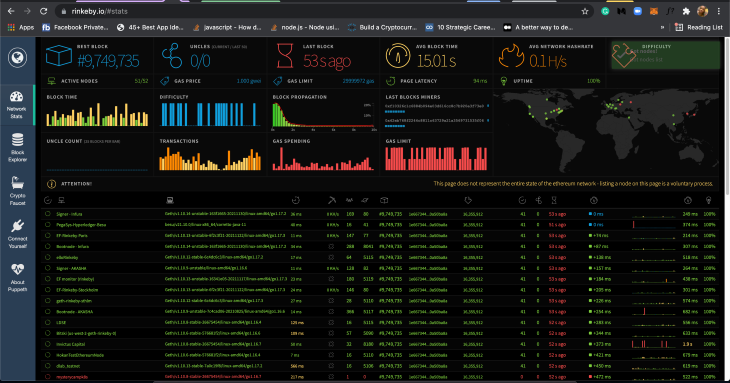
Loading the Rinkeby site at rinkeby.io will show you the Rinkeby network. Rinkeby displays the network stats, including the number of nodes, transactions, and blocks. In addition, it shows the number of transactions per second, the number of blocks per second, and the number of peers, which is the number of nodes that are connected to Rinkeby.
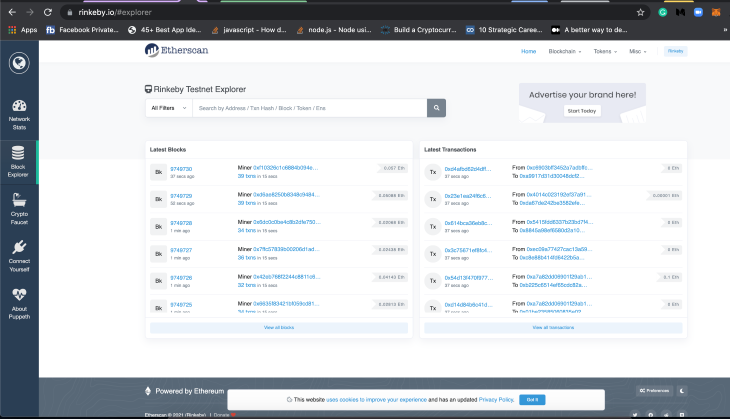
The Rinkeby site has a block explorer that will show you the blockchain in a readable format:
To write a smart contract and deploy it on the Rinkeby testnet, the first step is to install the MetaMask extension on your desktop browser.
First, go to the Chrome store and search for MetaMask. Click on the MetaMask extension and install it.
After the installation, go to the Chrome menu and click the Add-ons button. Then, click Extensions and then MetaMask.
MetaMask will pop up and prompt you to sign in. If you don’t have an account, you can create one by clicking the Create account button. After that, you can sign in to MetaMask.
Over 200k developers use LogRocket to create better digital experiences
 Learn more →
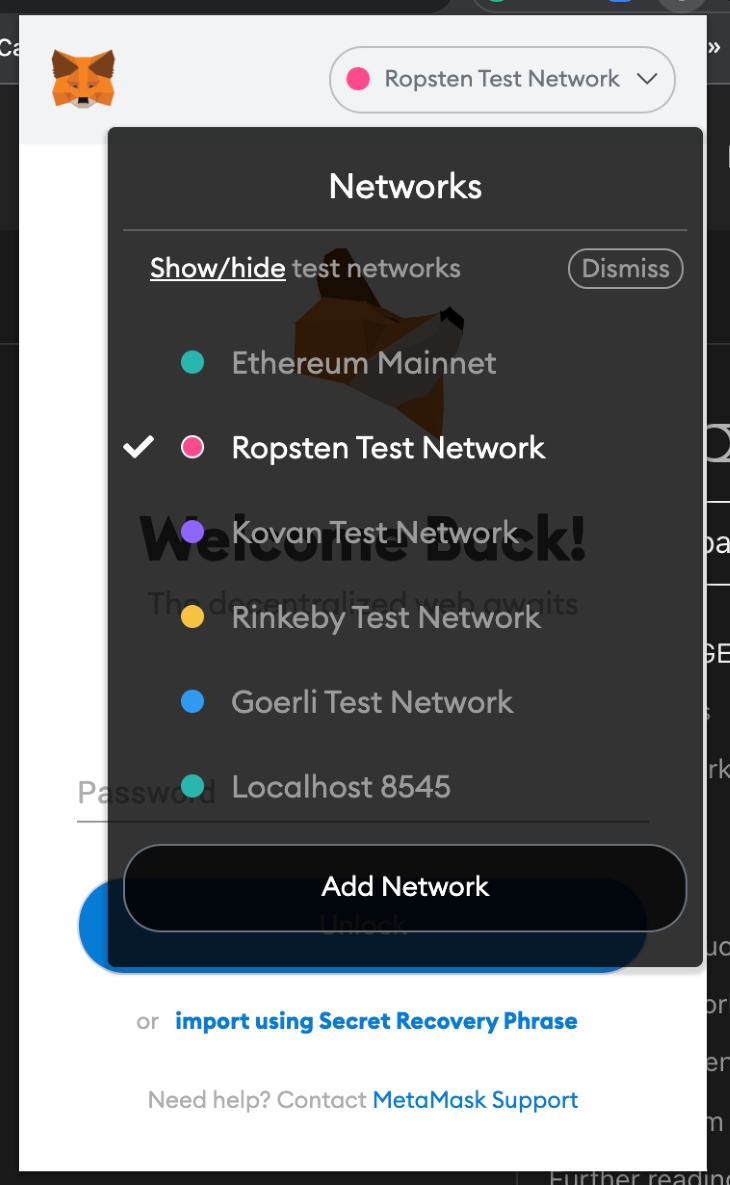
As you can see, there are several testnets to choose from, including Ethereum Mainnet, Rinkeby Test Network, Kovan Test Network, Ropsten Test Network, and Goerli Test Network. Localhost:8545 is an Ethereum node running locally on your machine.
Select the Rinkeby Test Network:
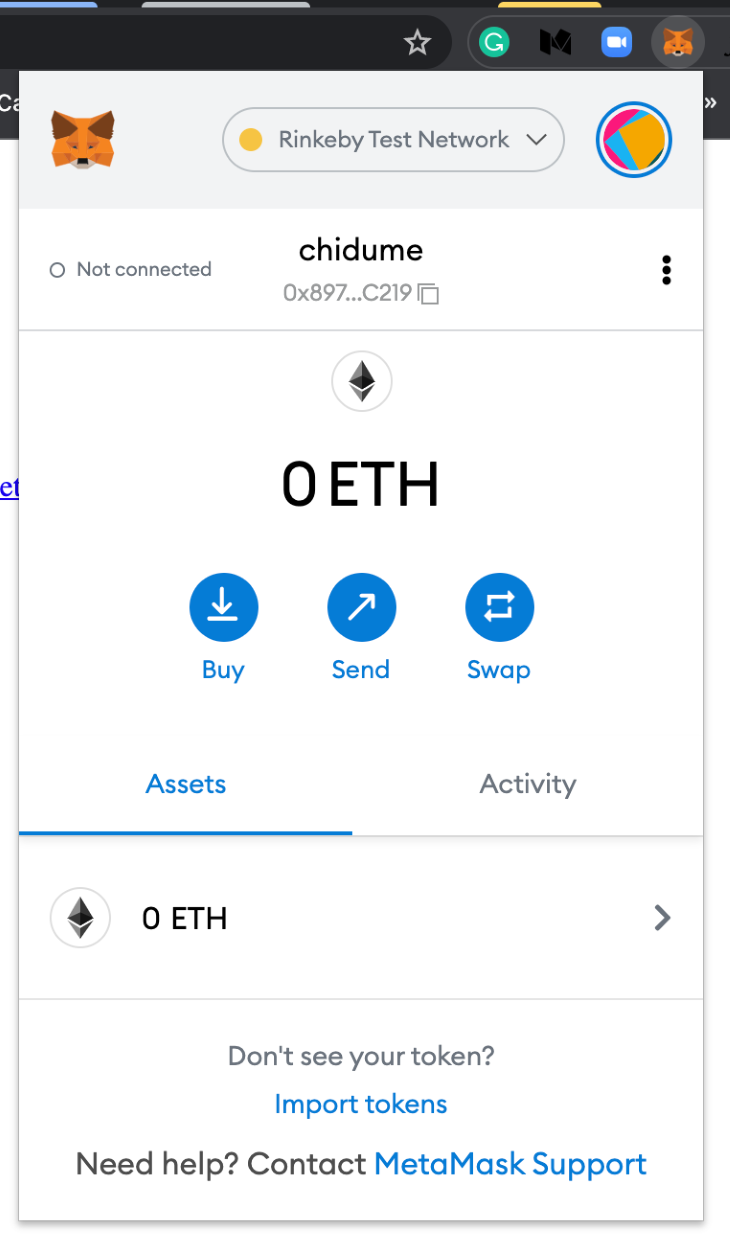
As you can see, we have 0 Eth.
First, we have to copy our Ethereum address. To do that, click the Copy icon to copy your Ethereum address.
Let’s see how we can get free Eth on the Rinkeby network. The official faucet is located here. Paste your Rinkeby testnet address and get free Eth.
There are also third-party sites that provide free Eth on the Rinkeby network, such as the Rinkeby Ether Faucet. Simply paste in your Ethereum address in the My Address field and click Submit to get a free Eth.
You can use the faucet found here if the above faucets don’t work.
| Authority | Faucet | Eth client |
|---|---|---|
| Proof of authority | https://faucet.rinkeby.io/ | Geth |
It is quite difficult to get free Eths on the Rinkeby faucet. It involves publishing a social media post for Rinkeby and waiting eight hours to earn 3Eth, one day to get 7.5 Eth, and three days to get 18.5 Eth. Thats a long time to to wait.
Rinkeby uses only the Geth client to make transactions on the network. This forces you to switch to the Geth client when making transactions on the Rinkeby network. This is another huge setback.
One key advantage is that Rinkeby uses proof of authority, which is quickly gaining adoption in the blockchain world.
Kovan
Kovan is another testnet that is used to test the Ethereum protocol. Like Rinkeby, Kovan is a fork of the mainnet.
Kovan was built in June 2017 by the Ethereum Foundation and, also like Rinkeby, is maintained by the Geth developer team. It uses the proof of authority consensus mechanism as well.
In general, Kovan supports the same features as Rinkeby. You can also use the official faucet to get free Eth on this Kovan testnet.
You can write ERC-20, ERC-721, and ERC-1155 tokens on the Kovan testnet. It shows the latest blocks, the latest transactions, and ERC-20, -721,- and 1155 tokens. You can also search addresses, transactions, blocks, etc.
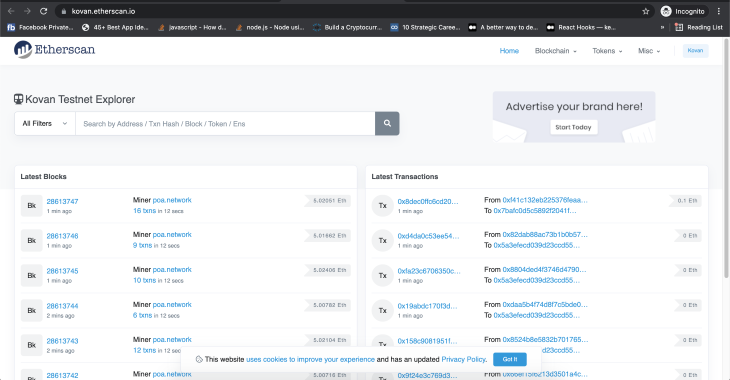
The free Ether we get in Kovan is called Kovan Ether (kEth). To get a free kEth in Kovan, you can use the official faucet. You can instantly get one KEth per 24 hours per GitHub account. You can also get free kEth in the Kovan Gitter chat room.
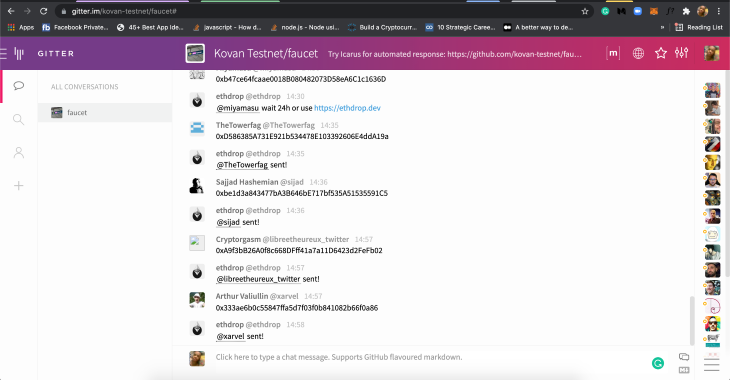
To get free kEth, join the chat room and paste your Kovan testnet address.
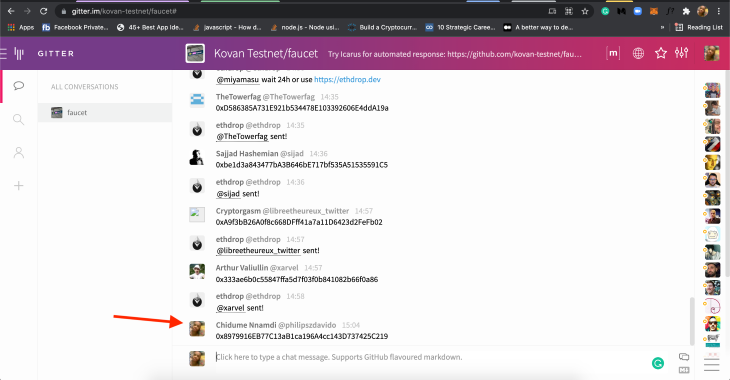
Now we have our free Eth!
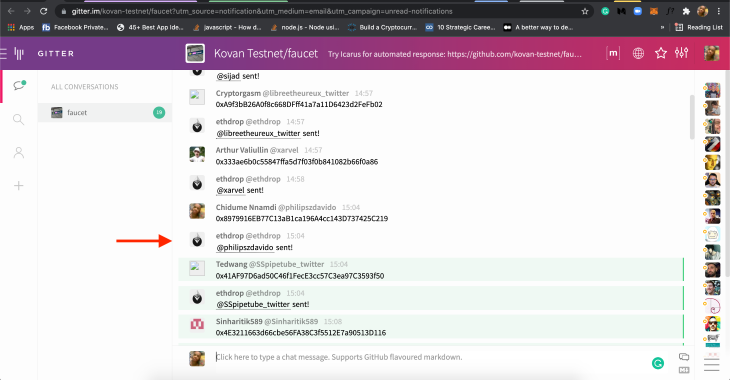
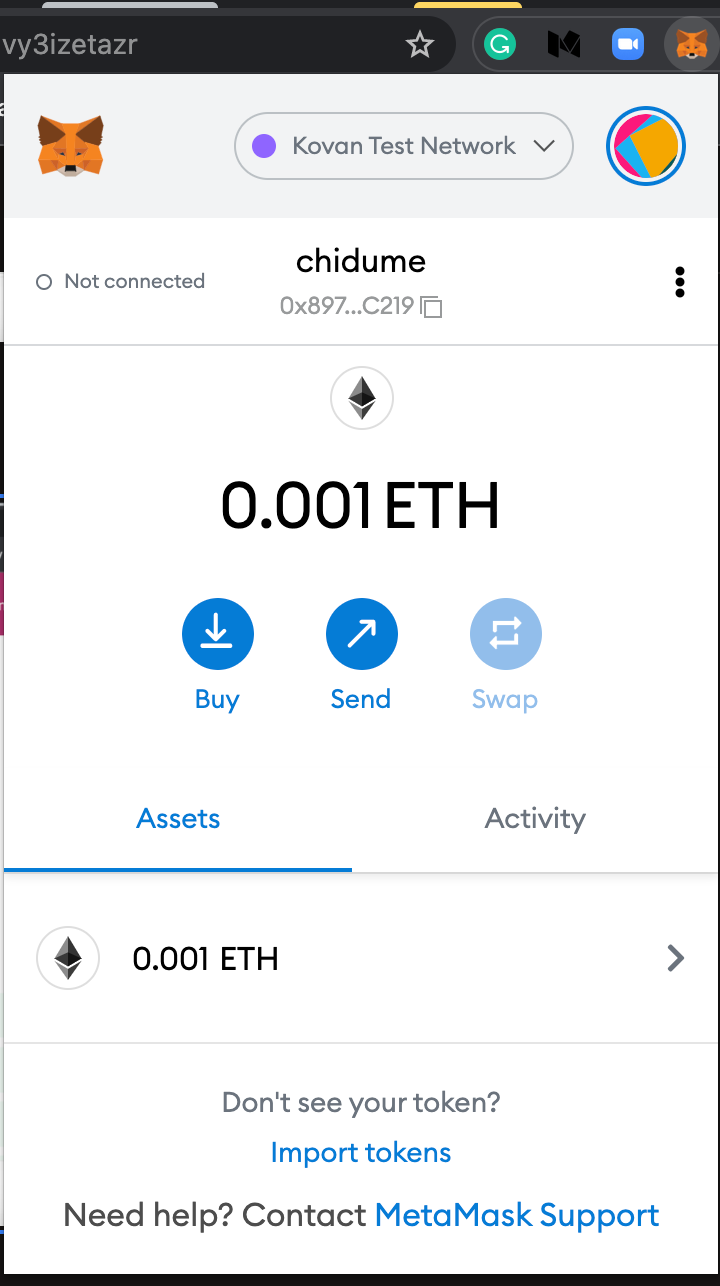
| Authority | Faucet | Eth client |
|---|---|---|
| Proof of authority | https://faucet.kovan.network/, https://gitter.im/kovan-testnet/faucet# | Parity |
Kovan uses the proof of authority consensus mechanism, unlike Ethereum, which uses the proof of stake consensus. This makes the Kovan testnet a bit different from the Ethereum mainnet it represents.
Getting free Eths on Kovan is relatively easy compared to other testnets. All you have to do is send your Eth address to the Kovan Gitter channel.
Ropsten
Ropsten was created in August 2017 by the Ethereum Foundation and, like many popular Ethereum testnets, is maintained by the Geth developer team. It uses the proof-of-authority consensus mechanism.
The Ropsten site, just like the Kovan test network site, shows the latest blocks and latest transactions. You can also view ERC-20, -721, and -1155 tokens as well as search addresses, transactions, blocks, etc.
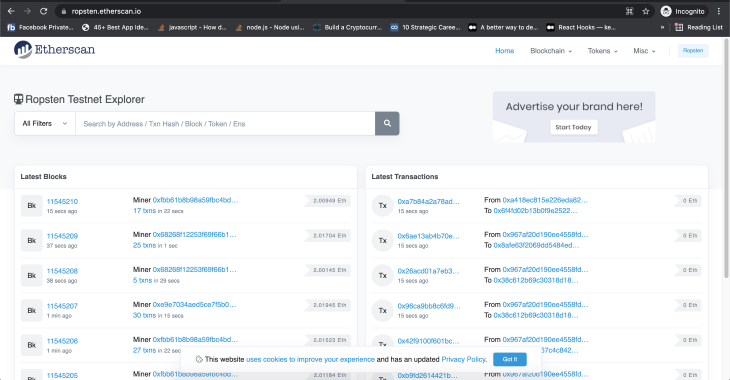
To get free Eth on the Ropsten testnet, we can use the official faucet.
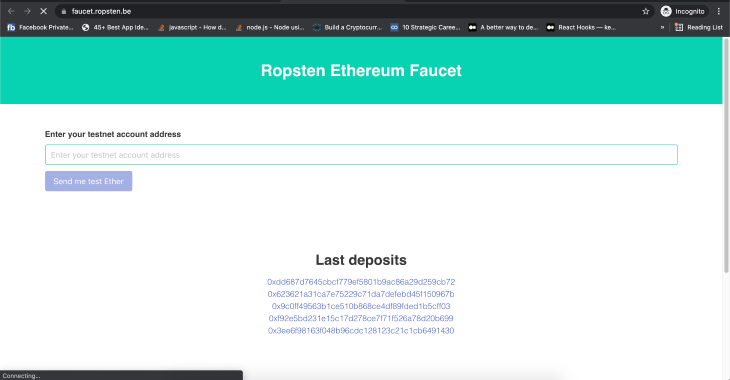
Just paste your Eth address and click Send me test Ether to get a free 0.3 Eth.
The Ropsten test network is considered to be the test network that is most closely related to the Ethereum Mainnet. The consensus mechanism is proof of work.
In February 2017, Ropsten was attacked and brought to a halt. The attacker raised the gas limit to 200m and the mining reward went up to 12 Eth. The attack was stopped and the Ropsten test network was restored in August 2017.
| Authority | Faucet | Eth client |
|---|---|---|
| Proof of work | https://faucet.ropsten.be/ | Geth, Parity |
The advantage of using Ropsten compared to other testnets is that it is the testnet that most faithfully emulates the Ethereum mainnet. Its consensus algorithm is same as the Ethereum mainnet, which makes it a great choice for Ethereum developers.
In addition, getting free Eths on Ropsten is easier than on other testnets. All you have to do is paste your Eth address on the faucet link to get 0.3 Eth in
5 minutes. Also, Ropsten supports Geth and Parity clients, which makes it highly comaptible compared to other testnets.
Goerli
Goerli was created in November 2018 by the Parity team. Like many of the testnets described above, it uses the proof of authority consensus mechanism.
The Goerli website displays the latest blocks and transactions, as well as ERC-20, -721, and -1155 tokens. Like the other testnets we’ve evaluiated, you can search addresses, transactions, blocks, etc., using Goerli.
Information about the most current releases of the Goerli testnet is available on GitHub.
You can sed free Eth to your Ethereum address in the Goerli testnet using the official Goerli Testnet Faucet. Simply paste your Ethereum address and press the REQUEST 0.05 GÖETH button to receive 0.05 GÖETH.
| Authority | Faucet | Eth client |
|---|---|---|
| Proof of Authority | https://goerli.etherscan.io/ | Geth, Parity (Goerli supports many Eth client) |
Conclusion
In this guide, we demonstrated how to get free Eth on the Rinkeby, Kovan, Ropsten, and Goerli Ethereum testnets. We also walked through how toget free Eth on these testnets using their respective faucets.
We started by introducing the concept of a testnet in the Ethereum network. From there, we delved into four popular Ethereum testnets, analyzed each, and pointed out their network sites, consensus mechanism, and faucets.
Join organizations like Bitso and Coinsquare who use LogRocket to proactively monitor their Web3 apps
Client-side issues that impact users’ ability to activate and transact in your apps can drastically affect your bottom line. If you’re interested in monitoring UX issues, automatically surfacing JavaScript errors, and tracking slow network requests and component load time, try LogRocket.https://logrocket.com/signup/
LogRocket is like a DVR for web and mobile apps, recording everything that happens in your web app or site. Instead of guessing why problems happen, you can aggregate and report on key frontend performance metrics, replay user sessions along with application state, log network requests, and automatically surface all errors.
55. What Is the Ethereum Rinkeby Testnet and How Does It Work?
Rinkeby is one of Ethereum’s test networks, which is a fully decentralized platform that supports smartcontracts. Testnets are used by developers to test applications, based on a given blockchain, before deploying them to the main network. The Rinkeby network is a publicly available testnet on Ethereum. Interestingly, however, it was phased out in 2022, just like the Ropsten and Kovan networks.
What Was the Ethereum Rinkeby Testnet Test Network?
As we mentioned in the title, it was an Ethereum test network. Used mainly by developers, to test decentralized applications, before deploying them to the main network.
Rinkeby was a fork of the main Ethereum network, run by authorized nodes. In this way, it prevented spam attacks and increased performance.
Developers used this network to get a free ETH testnet to try out their smart contracts. All without any risk of financial loss. The network itself was a test version, and the cryptocurrency contained in it – worthless. Importantly, no user was allowed to mine ETH on this testnet – they could only request it. The authorized nodes themselves were the only ones that created new blocks. This meant that no other node won a block reward.
It is worth mentioning that Rinkeby supported such nodes as: Geth, Besu, Nethermind and OpenEthereum. So why was such an “important” network deprecated?
So let’s start from the beginning. The Rinkeby Ethereum Testnet was launched in 2017 using a modified Proof-of-Authority consensus model. Why? So that instead of pointlessly staking something that has monetary value but is worthless, the identity of the validator is used for this activity. This ensured high network performance and fault tolerance.
The Rinkeby network itself was quite large. It contained about 11,000,000 blocks. In 2021 alone, the network had about 50 million transactions. While it was in use, as many as 46 nodes were active, and the block time for the network was about 15 seconds.
Did the network use gas? Of course. After all, it was built on Ethereum. The blockchain gas limit for this testnet was about 30 million.
A quick reminder: the gas limit refers to the maximum price an asset pays to transact or perform a function of a given smart contract on the Ethereum chain. Fees are charged in gas, and the limit determines its maximum value.
How Did Rinkeby Work and Why Was It the Developers’ Choice?
As we mentioned, the testnet was a network based on a Proof-of-Authority (PoA) consensus. In practice, this means that transactions were approved by nodes, not miners. Simply put, the network used consensus to create blocks.
It was the validators who were entrusted with creating new blocks, and they were selected based on their reputation and the amount of Rinkeby Ether they possessed. They were encouraged to create new blocks by receiving rewards in the form of Rinkeby Ether.
The test network itself also had a built-in block explorer and debugger that automatically allowed developers to debug their applications. This made Rinkeby a faster and more predictable network than Ethereum.
Not surprisingly, it became the developers’ choice. Rinkeby also had a shorter block time of about 15 seconds. For example, Ropsten, has a block time of about 30 seconds.
Moreover, the size of the chain data for the test network was less than 6 GB. What did this mean in practice? Running an Ethereum node for Rinkeby did not require a large data size.
Before its shutdown, Rinkeby was known as a reliable and fast test network.
Use Cases of the Rinkeby Test Network
The network was mainly used for application testing by developers. It was a great choice because the testing environment was controlled, worked practically like the Ethereum mainnet, and did not require the financial input associated with executing smart contracts.
As an interesting aside, we’ll tell you that Rinkeby has been used by companies such as OpenSea, Manifold Studios and even Rarible.
The second major use case was as an educational tool. Everyone gets it wrong – developers do too. Using a test network, in this case Rinkeby, allowed developers to better understand how to use the mainnet in the future.
And the last case, where developers used this network to test updates to the underlying platforms. This is an almost essential process, for creating better development tools for the entire Web3 ecosystem.
Pros and Cons of the Network
Using this Ethereum-based test network had its advantages and disadvantages. Let’s take a look at the key factors:
- First, Rinkeby was faster and more predictable than Ethereum. It made it easier for developers to test an application, making sure it worked properly.
- With its own currency, Rinkeby Ether (RNET), developers could test ideas in a more realistic environment.
- Transactions were approved by nodes, not miners. The network was therefore more secure and less vulnerable to attacks.
- Rinkeby provided a fast and reliable environment for Ethereum-based applications.
- The network was not intended for use in production environments. So in this aspect, it did not have the same level of security, reliability and performance as Ethereum.
- As a PoA network, it was less decentralized than the mainnet.
- If it were still operating today, it probably wouldn’t have the same level of support and resources as Ethereum.
- RNET had no value in the real world. It could not be traded or exchanged for other cryptocurrencies. Rinkeby Ether was only used for testing on the network.
Summary
When Rinkeby was in use, it worked well with other developer tools. It provided developers with great tools to create decentralized applications while using modern Web3 technology.