SHA-2 Algorithms
SHA-2 (Secure Hash Algorithm 2) is a set of cryptographic hash functions defined in RFC 6234: US Secure Hash Algorithms (SHA and SHA-based HMAC and HKDF).
The SHA-2 family consists of six hash functions with digests (hash values) that are 224, 256, 384 or 512 bits: SHA-224, SHA-256, SHA-384, SHA-512, SHA-512/224, SHA-512/256.
This library supports all of the algorithms mentioned above.
Implementation on FPGA
The internal structure of SHA-2 algorithms can be shown as the figure below:
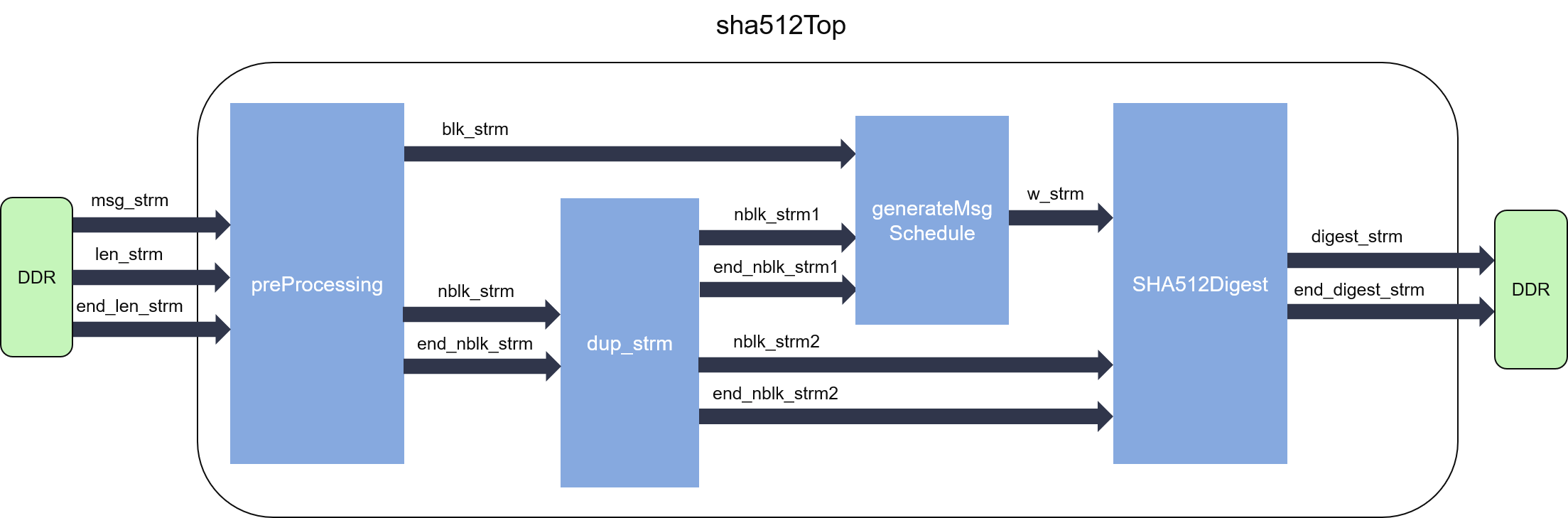
As we can see from the figure, the SHA-2 hash calculation can be partitioned into two main parts.
- The pre-processing part pads or splits the input message into fixed sized blocks, and informs the down-stream parts that how many blocks do we have in this message. The message word size is 32-bit for SHA-224/SHA-256, 64-bit for the rest 4 algorithms, and each block has a size of 16 message words.
- The digest part iteratively computes the hash values. Loop-carried dependency is enforced by the algorithm, and thus this part cannot reach II=1.
As these two parts can work independently, they are designed into parallel dataflow process, connected by streams (FIFOs).
The dup_strm module is used to duplicate the number of block stream, and generateMsgSchedule module is responsible for generating the message word stream in sequence.
Performance
SHA-224 and SHA-256
As SHA-224 is simply truncated SHA-256 with different initialization values, and they share the same internal structure, as illustrated in the figure above.
A single instance of SHA-256/SHA-224 function processes input message at the rate of 512 bit / 68 cycles at 330.25MHz/314.36MHz respectively.
The hardware resource utilizations of SHA-224 is listed in tab1SHA224 below:
| BRAM | DSP | FF | LUT | CLB | SRL | clock period(ns) |
| 0 | 0 | 7806 | 4976 | 1121 | 0 | 3.028 |
The hardware resource utilizations of SHA-256 is listed in tab1SHA256 below:
| BRAM | DSP | FF | LUT | CLB | SRL | clock period(ns) |
| 0 | 0 | 7806 | 4973 | 1176 | 0 | 3.181 |
SHA-384, SHA-512, SHA-512/224, and SHA-512/256
As SHA-384 and SHA-512/t is simply truncated SHA-512 with different initialization values, they share the same internal structure, as illustrated in the figure above.
A single instance of one of SHA-384/SHA-512/SHA512-224/SHA512-256 processes input message at the rate of 1024 bit / 84 cycles at 313.28MHz/323.31MHz/310.26MHz/313.57MHz.
The hardware resource utilizations of SHA-384 is listed in tab1SHA384 below:
| BRAM | DSP | FF | LUT | CLB | SRL | clock period(ns) |
| 0 | 0 | 15494 | 8317 | 2045 | 0 | 3.192 |
The hardware resource utilizations of SHA-512 is listed in tab1SHA512 below:
| BRAM | DSP | FF | LUT | CLB | SRL | clock period(ns) |
| 0 | 0 | 15497 | 8318 | 2015 | 0 | 3.093 |
The hardware resource utilizations of SHA-512/224 is listed in tab1SHA512224 below:
| BRAM | DSP | FF | LUT | CLB | SRL | clock period(ns) |
| 0 | 0 | 15498 | 8318 | 2101 | 0 | 3.223 |
The hardware resource utilizations of SHA-512/256 is listed in tab1SHA512256 below:
| BRAM | DSP | FF | LUT | CLB | SRL | clock period(ns) |
| 0 | 0 | 15497 | 8322 | 2029 | 0 | 3.189 |
Clustering
To boost the throughput of SHA-2 primitives, multiple instance can be organized into a cluster, and offer message level parallelism.
Introduction- What is SHA 2
SHA stands for Secure Hash Algorithm; it is an important cryptographic hashing algorithm for computer security. The US National Security Agency (NSA) was established with the help of other organizations including private and public ones. SHA-0 was the first edition of its kind, followed by SH-1 to the latest Sh-3 versions. National Security Agency introduced SHA-1 in 1993. It was the basic algorithm for signing digital certificates and certificate reversal lists.
Certificate Authorities use SHA hash functions for creating certificate reversal lists and digital certificates. A Secure Hash Algorithm is intended to produce special hash values from given files.
From 2011 to 2015, SSL Certificates used SHA-1 as the basic algorithm. However, that has since been moved up to SHA-2, which comes with six hash functions of various levels (224, 256, 384, 512, 512/224, 512/256). Any information about the SHA is incomplete without knowing about Hashing.
What is Hashing?
The hashing method is a unidirectional function that contracts data with the help of a numerical function. The hash value that we get from this method is unique for that particular data, no other piece of data contains the same hash value.
The value we get after hashing is named as hashed text. The other two named hash texts are hashed value and digest. The most important function of hashing is to provide security and privacy. For example, protecting the password and important data, fast-tracking the operation speed, and comparing data easily. There are several hashing algorithms available in the field, but SHA is the most used among these algorithms.
How is Hashing used with SSL?
SSL/TLS certificate providers use SHA algorithms for digital certificates. The purchased SSL certificates have a digital signature on them provided by the certificate authorities. Before delivering, authorities hash it with the help of SHA algorithms.
The distinctive hash value is confirmation that the SSL certificate has not changed since its issuance, and its data is also the same and not recreated. The hash value of an SSL certificate digital signature changes when someone tries to change or recreate it. If the hash values are different, it means your SSL certificate is compromised. Any such change alerts the browsers along with the operating system. The users will get a warning error about this development.
Why Upgrade SH-1 to SHA-2
In 2011 the CA/Browser platform decided to put in place basic operating guidelines for SSL Certificates. The developers found severe security vulnerabilities with SHA-1 that made most users’ information exposed. This leads to upgradation from SH-1 to SH-2. There are some vulnerabilities in SH-1, let’s have a look at them briefly.
1. Vulnerabilities of SHA-1
It is a well-known fact that SH-1 was the universal method to sign an SSL certificate in the 90s. Until 2013, 98% of SSL Certificates were using SHA-1 one. However, in the last 4 or 5 years, the increase in hacking attempts has raised a question on the reliability of the SHA-1. For many, relying on SH-1 alone was not secure anymore. That is why, developers decided to select a more developed hashing method, SHA-2. Compare to SHA-1, SHA-2 is very secure and interference-resistant. Further, SHA-2 has more compatibility and can be used with more technologically advanced computers.
2. Google and Microsoft Disapprove SHA-1
With the introduction of SHA-2 SSL certificates, major stakeholders decided to use it as a default algorithm. For example, Google Chrome gradually stop using SHA-1 SSL certificates in the year 2017. But in fact, even in 2014 Google Chrome announced publicly their SHA-1 non-compliance guideline as follows:
● Chrome 39 will show an error on the address bar for all SHA-1 SSL certificates, that are going to expire as late as January 1st, 2017.
● Chrome 40 showed a similar error notification for the websites with having certificates that are going to expire prior to January 1st in the year 2017. Chrome 41 will show a message that the site is insecure for all those websites using the SHA-1 certificates starting from 1st January in the year 2017.
Why Browsers prefer SHA-2 SSL Certificate?
This debate revolves around a very important question. Why SHA-2 SSL certificate is more secure and reliable algorithm than the SHA-1 SSL certificate? As we know, the SHA-1 Positive Multi-Domain Wildcard SSL Certificate comes with a 160-bit length signature. On the other hand, the SHA-2 SSL certificate uses hashes of various lengths and is more adaptable. One of the most utilized hashes includes the 265-bit hash.
Some of the remaining hashes include SHA-224*, SHA-512, and SHA-512/224, etc. The figure that comes after SHA represents how lengthy are the bit values. The higher length of the signature means the tougher the hash is to decode. This makes it more secure compared to SHA-1. Due to the high security, most of the browser prefers SH-2 certificate now. Some SHA-2 SSL certificates are signed publicly, for example, the SHA-224 SSL certificate. There is a question that arises, how long will SHA-2 be useful?
But, here a question arises, how long will the SHA-2 SSL certificate remain secure as it is today? When we produce a distinctive hash value using the hashing method, there is an upper limit for the number of sequences it can deliver. For example, SHA-256 can deliver 2256 different sequences of hashes. Now, 2256 is a big number. There is no way you can reach this number. At least not for years. So, it is safe to use SHA-2 SSL certificates for foreseeable future.
Now, if you are planning to install an SHA-2 SSL certificate, make sure to install it on a compatible server and browser. For better working, it is important to install the SHA-2 SSL certificate on a compatible server or browser.
The Final Words
Technology brings its advantages to our life as well as its disadvantages. We always want to keep ourselves secure while using the internet. The SSL certificates are the key to our online security. It is up to us to choose the most reliable source to buy an SSL certificate for our website. The SHA-2 SSL certificates are more reliable and secure to use. The SHA-2 SSL certificate numerous advantages over the SHA-1 SSL certificate. Most important is its diversity in hash values. This makes it more reliable as compare to SHA-1 when it comes to online privacy and security.
What is SHA2 Hash? An In-depth Guide with Examples

What is SHA2? Dive into the World of Secure Hash Algorithms
Greetings! Let’s embark on a fascinating journey to demystify SHA2, or Secure Hash Algorithms 2, an intriguing component of cryptography that adds a layer of security to our digital world.
In the late 1990s, amidst burgeoning technological advancements and the dawn of a new digital era, security became a growing concern. Enter SHA2, which came into existence as a response to these security challenges. Born from the brilliance of the National Institute of Standards and Technology (NIST) and the National Security Agency (NSA), SHA2 offered an innovative approach to safeguarding digital information.
What is SHA2? A Brief Overview
SHA2 is a family of cryptographic hash functions that play an integral part in ensuring the integrity and security of digital data. It’s akin to a mathematical algorithm that takes input or ‘message,’ and then returns a fixed-size string of bytes, typically a ‘message digest’.
When you look at SHA2, you might wonder, “Isn’t it just a bunch of numbers and letters?” Well, in reality, it’s a security workhorse, a virtual locksmith, if you will, that keeps our sensitive digital data locked away from prying eyes. Let’s explore this intriguing concept further.
SHA2: The Origin Story
In the world of technology, where adaptability is paramount, SHA2 made its appearance following its predecessor, SHA1. The successor came with a set of six hash functions sporting different digest sizes: SHA-224, SHA-256, SHA-384, SHA-512, SHA-512/224, and SHA-512/256. The difference in numbers? That refers to the length of the hash that the function generates, with SHA-256 producing a 256-bit hash from any input, for example.
The Mechanism Behind SHA2
Before we delve into the intricacies of SHA2, let’s do a little mind exercise. Imagine your favorite secret recipe. You put in all the ingredients (the input data), follow the steps (the algorithm), and voila – you have a delicious dish (the hash). Just like the recipe that transforms raw ingredients into something mouth-watering, SHA2 takes raw data and transforms it into a unique hash.
Here’s how it works:
- The input data is divided into blocks.
- Each block undergoes several rounds of operations.
- These operations are bitwise operations and logical functions.
- The end result? A unique hash value.
One fascinating aspect of SHA2 (or any hash function, really) is that even a minute alteration to the input data causes a significant change in the resulting hash – a phenomenon cryptographers lovingly refer to as the ‘avalanche effect’.
Understanding SHA2 Hash Function
Now, let’s dive into the heart of our subject – Hash Function. In layman’s terms, a hash function takes in data, chews it up, and spits out a hash. This hash, however, isn’t just a random jumble of numbers and letters. A hash function is like a data blender, and the resulting smoothie (the hash) has the distinct flavor of the original ingredients.
For example, let’s take a simple sentence like “Hello, World!” If we run this sentence through a hash function, we’d get a unique hash. And guess what? If we even change a tiny bit of the original sentence, say “hello, World!” (lowercase ‘h’), the hash will come out completely different.
Here’s a quick illustration:
| Input | SHA256 Hash |
|---|---|
| Hello, World! | dffd6021bb2bd5b0af676290809ec3a53191dd81c7f70a4b28688a362182986f |
| hello, World! | 04aa5d2533987c34839e8dbc8d8fcac86f0137e31c1c6ea4349ade4fcaf87ed8 |
SHA256 Hash of Strings
There you have it, a glimpse into the captivating world of SHA2 Hash and hash functions. But hang on, we’re not done yet. Join me in the next section where we’ll explore how this magical tool is used in real-world scenarios.
The Utility of SHA2 in the Digital Landscape
In a world where data is the new oil, the importance of SHA2 becomes paramount. SHA2 ensures that our precious data, be it passwords, documents, or credit card details, are secure from cyber threats.
Password Protection
Have you ever wondered how your passwords remain secure, even when a service you use faces a data breach? Say hello to hashing. When you create an account on a website, instead of storing your password as-is, the site stores the SHA2 hash of your password. This way, even if someone gets their hands on the hash, they can’t reverse-engineer your password.
Data Integrity
SHA2 also plays a crucial role in maintaining data integrity. By comparing the hash values of data before and after transmission, we can ensure that the data hasn’t been tampered with during transit.
The pros and cons of SHA2 Hash – The Good, the Bad, and the Ugly
Benefits of SHA2
SHA2 comes with an impressive array of benefits that makes it a popular choice in cryptography:
- Improved Security: With its long hash lengths, SHA2 offers a higher level of security against attacks compared to its predecessors. 2. Data Integrity: It ensures that the data remains intact and unaltered during transmission. 3. Password Protection: SHA2 hashing protects passwords by storing their hash instead of the actual password.
Limitations of SHA2
However, like everything else under the sun, SHA2 isn’t without its limitations:
- No Encryption: SHA2 is a hash function, not an encryption function. Hence, it doesn’t offer two-way functionality.
- Vulnerable to Collision Attacks: Though challenging, it’s theoretically possible to find two different inputs that produce the same hash, termed as a collision.
- Performance: SHA2, particularly the variants with longer hash lengths, can be computationally intensive, which can be a downside in systems with limited resources.
SHA2 in Practice
To grasp how SHA2 works in real-world scenarios, let’s consider the process of downloading a file from the internet. We’ve all been there, haven’t we? Now, imagine the website provides a SHA2 hash value for the downloaded file.
After the download completes, you generate the SHA2 hash of the file on your system and compare it with the hash provided on the website. If the two hashes match, rest assured, the file has downloaded correctly and hasn’t been tampered with during transit.
FAQs about SHA2
- What is the difference between SHA1 and SHA2?SHA1 and SHA2 are both cryptographic hash functions, but SHA2 is more secure due to its longer hash lengths. Additionally, SHA1 has been found to be vulnerable to collision attacks, which is less likely with SHA2.
- Is SHA2 reversible?No, SHA2 is not reversible. This characteristic is actually a security feature since it prevents anyone from deriving the original input from the hash.
- Can two different inputs have the same SHA2 hash?While it is theoretically possible (known as a collision), the chances are astronomically low, making SHA2 secure for practical purposes.
- Is SHA2 still secure?As of my writing in 2023, SHA2 is still considered secure and is widely used in cryptographic applications.
- What can replace SHA2 in the future?NIST has initiated a process to develop SHA3, which would eventually replace SHA2. However, as of now, SHA2 remains in widespread use.
- Is SHA2 the same as SHA256?SHA256 is a member of the SHA2 family, which includes other variants like SHA224, SHA384, SHA512, SHA512/224, and SHA512/256. The numbers refer to the length of the hash produced by the algorithm.
A Concluding Note on SHA2
So there you have it! We’ve embarked on an enlightening journey through the world of SHA2, unraveling its layers and understanding its pivotal role in ensuring digital security.
Through the lens of SHA2, we’ve explored how this magnificent piece of cryptographic technology safeguards our data and adds a layer of security to the vast digital landscape we navigate every day. It’s fascinating to think about all the covert operations these algorithms perform behind the scenes to keep our digital lives secure, isn’t it?
While SHA2, like any other technology, isn’t without its limitations, its benefits far outweigh its shortcomings. And until a new cryptographic hero arrives to take its place, SHA2 continues to be our trusted guardian in the digital world.
Now, every time you type in a password or download a file, spare a thought for the hard-working SHA2. After all, this humble hash function is the unsung hero that quietly weaves its magic, keeping our digital secrets safe and secure.
- Website
- X (Twitter)
Satvik is a passionate developer turned Entrepreneur. He is fascinated by JavaScript, Operating System, Deep Learning, AR/VR. He has published several research papers and applied for patents in the field as well. Satvik is a speaker in conferences, meetups talking about Artificial Intelligence, JavaScript and related subjects. His goal is to solve complex problems that people face with automation.
Пошагово объясняем, как работает алгоритм хеширования SHA-2 (SHA-256)
Пошагово разбираемся в алгоритме хеширования SHA-2 (SHA-256) и показываем, как он работает, на реальном примере.
Автор Мария Багулина
SHA-2 (Secure Hash Algorithm 2) — одно из самых популярных семейств алгоритмов хеширования. В этой статье мы разберём каждый шаг алгоритма SHA-256, принадлежащего к SHA-2, и покажем, как он работает на реальном примере.
Что такое хеш-функция?
Если вы хотите узнать больше о хеш-функциях, можете почитать Википедию. Но чтобы понять, о чём пойдёт речь, давайте вспомним три основные цели хеш-функции:
- обеспечить проверку целостности (неизменности) данных;
- принимать ввод любой длины и выводить результат фиксированной длины;
- необратимо изменить данные (ввод не может быть получен из вывода).
SHA-2 и SHA-256
SHA-2 — это семейство алгоритмов с общей идеей хеширования данных. SHA-256 устанавливает дополнительные константы, которые определяют поведение алгоритма SHA-2. Одной из таких констант является размер вывода. «256» и «512» относятся к соответствующим размерам выходных данных в битах.
Мы рассмотрим пример работы SHA-256.
SHA-256 «hello world». Шаг 1. Предварительная обработка
1. Преобразуем «hello world» в двоичный вид:
2. Добавим одну единицу:
3. Заполняем нулями до тех пор, пока данные не станут кратны 512 без последних 64 бит (в нашем случае 448 бит):
4. Добавим 64 бита в конец, где 64 бита — целое число с порядком байтов big-endian, обозначающее длину входных данных в двоичном виде. В нашем случае 88, в двоичном виде — «1011000».
Теперь у нас есть ввод, который всегда будет без остатка делиться на 512.
Шаг 2. Инициализация значений хеша (h)
Создадим 8 значений хеша. Это константы, представляющие первые 32 бита дробных частей квадратных корней первых 8 простых чисел: 2, 3, 5, 7, 11, 13, 17, 19.
Шаг 3. Инициализация округлённых констант (k)
Создадим ещё немного констант, на этот раз их 64. Каждое значение — это первые 32 бита дробных частей кубических корней первых 64 простых чисел (2–311).
Шаг 4. Основной цикл
Следующие шаги будут выполняться для каждого 512-битного «куска» входных данных. Наша тестовая фраза «hello world» довольно короткая, поэтому «кусок» всего один. На каждой итерации цикла мы будем изменять значения хеш-функций h0 – h7 , чтобы получить окончательный результат.
Шаг 5. Создаём очередь сообщений (w)
1. Копируем входные данные из шага 1 в новый массив, где каждая запись является 32-битным словом:
2. Добавляем ещё 48 слов, инициализированных нулями, чтобы получить массив w[0…63] :
3. Изменяем нулевые индексы в конце массива, используя следующий алгоритм:
- For i from w[16…63] :s0 = (w[i-15] rightrotate 7) xor (w[i-15] rightrotate 18) xor (w[i-15] righthift 3)s1 = (w[i-2] rightrotate 17) xor (w[i-2] rightrotate 19) xor (w[i-2] righthift 10)w [i] = w[i-16] + s0 + w[i-7] + s1
Давайте посмотрим, как это работает для w[16] :
Это оставляет нам 64 слова в нашей очереди сообщений ( w ):
Шаг 6. Цикл сжатия
- Инициализируем переменные a, b, c, d, e, f, g, h и установим их равными текущим значениям хеша соответственно. h0, h1, h2, h3, h4, h5, h6, h7 .
- Запустим цикл сжатия, который будет изменять значения a…h . Цикл выглядит следующим образом:
- for i from 0 to 63 S1 = (e rightrotate 6) xor (e rightrotate 11) xor (e rightrotate 25)ch = (e and f) xor ((not e) and g)temp1 = h + S1 + ch + k[i] + w[i]S0 = (a rightrotate 2) xor (a rightrotate 13) xor (a rightrotate 22)maj = (a and b) xor (a and c) xor (b and c)temp2 := S0 + majh = gg = ff = ee = d + temp1d = cc = bb = aa = temp1 + temp2
Давайте пройдём первую итерацию. Сложение рассчитывается по модулю 2^32:
Все расчёты выполняются ещё 63 раза, изменяя переменные а … h . В итоге мы должны получить следующее:
Шаг 7. Изменяем окончательные значения
После цикла сжатия, но ещё внутри основного цикла, мы модифицируем значения хеша, добавляя к ним соответствующие переменные a … h . Как обычно, всё сложение происходит по модулю 2^32.
Шаг 8. Получаем финальный хеш
И последний важный шаг — собираем всё вместе.
Готово! Мы выполнили каждый шаг SHA-2 (SHA-256) (без некоторых итераций).
Алгоритм SHA-2 в виде псевдокода
Если вы хотите посмотреть на все шаги, которые мы только что сделали, в виде псевдокода, то вот пример: