В чём заключается отличие инвойса от проформы?
В сфере международных грузоперевозок применяются такие понятия как инвойс и проформа, хорошо известные таможенным специалистам, но непонятные для многих перевозчиков и участников бизнес-процесса. Эти два понятия часто путают, и дают им неверные формулировки. Это и неудивительно, ведь даже на официальных сайтах учреждений их описывают по-разному, и без уточнения конкретных отличий. На самом деле, отличия есть, хотя эти два документа действительно очень похожи между собой. Сначала стоит дать их точные характеристики.
Commercial Invoice (коммерческий инвойс) – это документ международного значения, передаваемый от продавца покупателю при осуществлении товарной сделки. Его также называют инвойс-фактурой, и составляют только на основании заключенного контракта. На внутреннем (внутрироссийском) рынке он не используется, и необходимость в нем возникает только при международных грузоперевозках.
Какую информацию содержит в себе инвойс? Он содержит в себе исчерпывающие сведения о транспортируемом товаре, включая его массу, материалы изготовления, цвет, назначение и т.д. Важнейшие пункты инвойса – количество и окончательная стоимость товаров, а также достоверная информация об их отправителе и получателе. В инвойс-фактуре подробно описываются условия договора, и ее можно считать полноценным платежным документом для совершения банковских платежей. Кроме того, ее можно использовать для оформления таможенных сборов.
В отличие от инвойса, проформа может применяться как на внешнем, так и на внутреннем рынке (на территории РФ), и составляться без заключения контракта. Ее также называют счетом-проформой и проформой-инвойсом. Отчасти, из-за второго названия и возникла путаница между этими отличными друг от друга документами. Но общего между ними действительно очень много, и в проформе тоже указываются сведения о грузе, его количестве и стоимости. Только последняя может быть не окончательной, а промежуточной, что дает возможность отгружать не 100%, а лишь часть транспортируемого товара.
В проформе также содержится информация об отправителе и получателе, и она может использоваться как платежный документ – вместо контракта. При ее наличии можно проводить растаможку и авансовые банковские платежи. Если в инвойсе обязательно указывается окончательная стоимость груза, то в проформе она может быть вообще не указана – даже в промежуточном виде. Это дает возможность перевозить грузы на «безвозмездной» основе, например – экспонаты выставок, научные образцы, и т.д. Причем – не только на международном рынке, но и внутри страны.
Зная определения и назначение инвойса и проформы, можно четко сформулировать отличия между ними. При кажущейся (для дилетантов) идентичности, они отличаются по целому ряду пунктов, к которым отнесем следующие:
- Проформу можно оформлять без контракта, а для инвойса его наличие обязательно;
- В инвойсе должны указываться окончательная стоимость и количество товара, а в проформе – необязательно;
- Проформа дает возможность отгружать товар частично, а инвойс – только в полном объеме;
- Проформа дает возможность перевозить грузы, не имеющие оценочной стоимости;
- Инвойс не может применяться во внутренней экономической деятельности.
В ряде случаев документы могут заменять друг друга, но гораздо чаще их применение расходится. Если говорить о внешнеэкономической деятельности (продаже и покупке товаров за границей), то для нее гораздо важнее инвойс, чем проформа. Он обеспечивает надежные гарантии (за счет указанной окончательной стоимости), и может выступать в качестве полноценного платежного и таможенного документа. К его составлению и оформлению нужно подходить с максимальной внимательностью, в идеале – заручившись помощью профессионального таможенного брокера.
Commercial Invoice (CI)
The Commercial Invoice describes the entire export transaction and shipping terms, and it is used to calculate your import duties and taxes.
Our shipping glossary contains all the terms you need to know explained in simple language with FAQs and examples. ����✌️
What is a Commercial Invoice?
The Commercial Invoice (CI) is a legal document describing the entire export transaction and shipping terms: the prices, value of the goods, payment terms, and total invoice value.

Why do you need a Commercial Invoice?
It provides the total value of your shipment, which is then used to calculate your import duties and taxes.
Is it a must-have?
Yes! It is one of the most important documents you will need to carry out your shipment.
Who prepares the Commercial Invoice?
The factory or the seller.
What information should a Commercial Invoice contain?
A good Commercial Invoice must contain the following:
• Shipping transaction (date, invoice number, terms of sale)
• Details of goods being transported ( packing list )
• Harmonized System Codes for those goods (aka HS Codes)
• Details of the exporter and receiver
• Country of origin (country of manufacture)
Sales Value vs Purchase Value. Which should you put on your Commercial Invoice?
It depends on who you’re shipping to.
As a buyer, if you’re shipping to your warehouse , put Purchase Value! You don’t want to pay unnecessary duties and taxes.
As a buyer, if you’re shipping to your retailer’s warehouse or your customer, put Sales Value! You don’t want your retailer or customer to know your purchase price.
Note: Taxes and duties will be based on the total value listed on the Commercial Invoice.
-p-500.png)
Logistics nerd and resident marketing guy of Bookairfreight. I love writing content that simplifies old-fashioned industry processes and provides solid, accurate information you can base your decisions on. Outside of logistics, I enjoy nature, hanging out with friends, electronic music and spirituality.

Say goodbye to industry jargon.
Download our free shipping terms glossary! ����
You’ll Also Love ❤️.

The Packing List is one of the most important documents you need when exporting and importing.

Harmonized System (HS) is an internationally recognized system of numerical codes that help with identifying the category of the goods being shipped.

When it comes to freight, weight is not just weight! The size of your goods could change the chargeable weight of your shipment.

The consignor sends the goods, and the consignee receives them.
Take Your Logistics to the Next Level.
Sign up for free and get access to 60% cheaper freight rates from top forwarders all over the world.
Commercial invoice что это
A commercial invoice is one of the most important documents for every business that sells services and goods internationally. After all, a single mistake in your commercial invoice could end up in penalties or paying fines , and that’s the last thing you want your business to focus on.
If you want to learn all about commercial invoices, how to make one easily, and how to avoid any problems with customs authorities, you’ve come to the right place!
This article will break down all the important details regarding commercial invoices and show you how to make one with a generator so you can meet customs authority standards and regulations!
Key Takeaways
- A commercial invoice is used by businesses and sellers to request payments for internationally sold or shipped goods.
- It contains general information about the seller and buyer, payment terms, HS code, shipping and product details, invoice date and number, etc.
- Print three copies of the commercial invoice: one for the country where the product is exported, one for the country where the product will be shipped, and one for the buyer.
- The easiest and most efficient way to make a commercial invoice is to use an online invoice generator.
What is a Commercial Invoice?
A commercial invoice is a key export document businesses issue to solicit payment for internationally sold goods or services .
Customs authoritiesare responsible for regulating imports.They warrant commercial invoices to evaluate which taxes and tariffs are applicable to the goods you are exporting.
Commercial invoices often follow a pro forma invoice . A pro forma invoice is first sent to the buyer to give them an idea of the cost that will be reflected in the final invoice.
When is a Commercial Invoice Required?
You must present a commercial invoice when shipping goods across international borders. For example, if you’re a business based in the US that exports products to sell to a buyer who lives in Asia, you’re required to issue a commercial invoice.
However, if the shipment occurs within the same country, then a commercial invoice is unnecessary . This is also true in interstate shipping arrangements, such as when goods are sent from one US state to another.
What Does a Commercial Invoice Include?
The following are the essential details to include in a commercial invoice for international shipping:
#1. General Information
General information pertains to the buyer's and seller’s information. This includes their full name, street address, contact details, logo, postal code, city, and country. If the buyer is a business entity, then include their tax ID number in the invoice.
#2. Invoice Date and Number
The invoice date is the date the invoice is issued.
Invoice numbers , on the other hand, must be unique and sequentially arranged to keep your orders and inventory organized and help track which orders have been processed or need follow-up.
The chronological invoice numbering system is one of the go-to formats used by most businesses. It includes the date and the sequential number for the invoice, which should appear like this: “2023-01-01—0005”.
Another format you can use is customer invoice numbering , which entails assigning a number combination to each of your customers, followed by the issue date and the sequence number. Say you assigned the number ‘44’ to Customer A. The invoice number should look like this: “44-2023-03-28—0007”
#3. Shipping and Product Details
The shipping and product details include anitemized list of goods or products to be shipped. The customs department uses the list to check the contents, items, and prices of the package.
It must contain the following details:
- Item code (Stock Keeping Unit/SKU Number). Retailers assign an alphanumeric combination to each product for inventory and supply management.
- Product name. The name of the product and a brief description.
- Quantity. The number of items or products in the package.
- Net weight. The weight of the product that discounts the added weight of its packaging.
- Gross weight. The combined weight of both the item and the packaging.
- Unit price. The individual value of the item per unit of weight or volume.
- Total price. The total amount of the products in the package per product line.
- Subtotal. The combined total price for each item.
#4. Harmonized System (HS) Code
The HS code is used to classify goods based on the type, purpose, and nature of the product. It enables customs tax authorities to assess the correct amount of taxes and tariffs to impose on the product and determine any additional actions that must be implemented when handling and shipping the product.
The Harmonized System Code is updated every five years by the World Customs Organization . If you are unsure about the correct codes to use for your items, contact your local tax agency or the manufacturer of the goods you are selling.
#5. Country of Origin
The country of origin refers to the country exporting the goods. If you are shipping to Haiti, Namibia, Bolivia, Pakistan, or Cambodia, you are required to provide a Certificate of Origin (CO) .
The CO provides a substantial reference for assessing your eligibility as a seller to export goods to a specific country .
#6. Payment Terms
The payment terms detail the concise time frame the buyer must follow to complete the payment for the goods. It informs the buyer of the exact amount to pay for the item and the payment methods they can use.
Payment terms also highlight internationally recognized terms of sale overseeing the export and import of goods by clarifying who is responsible for the following:
- Shouldering shipping costs, product insurance, and added charges made by the customs department
- Transporting the products from one point to another
- Handling and overseeing the goods at each stage of delivering the product
#7. Additional Notes
Additional notes contain any extra information that must be passed on to the buyer or customer. It can either be added payment instructions , warranty details , or even a simple ‘thank you’ note .
Commercial Invoice Glossary
Here are some of the most common terms you can find on a commercial invoice:
Terms
Definition
Actual Gross Weight
The total weight of the product.
Country of Origin
The country where the shipped goods originated or are produced.
The buyer (could be an individual or a business) to whom the products are being sent or shipped.
CO (Certificate of Origin)
A document that helps verify the country where the product is manufactured or produced.
The currency in which the values of the items are listed in.
A document that is required for specific merchandise that entails a license exception .
The transport costs for the item or package.
HS (Harmonized System) Code
It classifies goods based on product type, nature, and purpose for tax purposes.
Incoterm / Terms of Sale
The billing and payment terms agreed upon by the buyer and seller.
Invoice Line Total
The total price of all items plus the packaging weight in the shipment.
The total weight of the goods to be shipped, minus the packaging’s added weight.
The payment method and the number of days that the buyer must follow to fulfill the payment for the goods ordered.
It contains an appraisal cost that will be reflected in the final invoice.
Reason for Export
It specifies the objective for exporting the goods, such as making a sale or supplying items for a business operation.
Quantity of Units
The number of items per unit contained within the package.
A type of tax levied on imported products.
The corresponding value per unit of the item.
Tax Identification Number
A tracking number issued by the SSA or IRS to monitor taxes. It is also used to identify businesses acting as buyers in transactions.
It is similar to the Tax Identification Number, albeit used in European businesses or companies.
Employee Identification Number (EIN)
This is the US counterpart of a VAT ID.
How to Create a Professional Commercial Invoice Effortlessly
Our invoice generator comes with free templates and a built-in calculator that lets you produce error-free and professional-looking commercial invoices . It’s super easy to use, and all you have to do is:
- Open the invoice generator .
- Fill in all the blank fields with the correct information.
- Preview the document and download it.
You’ll receive your commercial invoice in an instant and you’ll be able to forward it effortlessly via mail or email in digital format .
What to Do After Making a Commercial Invoice?
Once your commercial invoice is finalized, print three separate copies of the document . You must provide a copy for:
- The buyer
- The country exporting the goods
- The destination country to which the product or goods will be shipped
Make sure that all three copies of your commercial invoice are stored safely to keep them from being tampered with or lost. Secure the first two copies in a packing list envelope and place the copy that is meant for the buyer inside the package.
Commercial Invoice FAQ
#1. What should a commercial invoice include?
A commercial invoice includes the seller and buyer’s names and contact information, the invoice number and date, shipping and product details, the HS code, the country of origin, and payment terms.
#2. Can I make my own commercial invoice?
Yes, you can make your own commercial invoice. The best way to do this is to use a free online generator.
#3. What is the difference between a commercial invoice and invoice?
A commercial invoice is used in the international sale and shipment of goods. A standard invoice is used by sellers in locally based transactions to request payments for their services and goods.
#4. What is the main purpose of a commercial invoice?
A commercial invoice is used mainly to request payment for internationally sold services and goods. It ensures that sellers abide by the globally recognized trade and sale regulations.
Final Thoughts
A commercial invoice is a must if you want to sell your products and services globally . It provides all the key information about your product that the customs authorities in your target destination must know for them to impose the correct taxes, tariffs, and duties on the shipment.
Preparing commercial invoices takes on a higher standard when it comes to consistency and precision. Understandably, you might eventually find yourself pressed for time to generate perfect invoices from scratch for all your international clients.
With our generator, you can create commercial invoices in just a few minutes! We can also help you make W-2 forms , 1099-MISC , and more!
Что такое инвойс: объясняем простыми словами
Чтобы получить плату за услуги от иностранных контрагентов, обычного счёта недостаточно — нужно оформлять инвойс. Рассказываем, как это сделать.

Иллюстрация: Polina Vari для Skillbox Media

Инвойс — документ, который используют для выставления счёта и запроса оплаты товаров или услуг. Инвойсы — неотъемлемая часть международных бизнес-процессов.
Правильное оформление и использование инвойсов помогает установить ясные условия оплаты, избежать недоразумений на таможне и гарантировать своевременное получение денег за проданные товары или предоставленные услуги.
В статье рассказываем главное об инвойсах и объясняем, как их заполнять.
-
инвойс
- Зачем используют инвойсы в России
- Какие есть виды инвойсов
- Как заполнить инвойс инвойса
Что такое инвойс
Инвойс (invoice) — это официальный документ, который продавцы используют для выставления покупателю счёта на оплату. Инвойс содержит информацию о деталях сделки, таких как наименование товара или услуги, их количество, цена, общая сумма к оплате и метод оплаты.
Представьте, что вы покупаете товар в интернет-магазине. Когда вы оформляете заказ и готовы совершить оплату, магазин отправляет вам инвойс. В этом документе указана общая сумма к оплате, а также информация о товарах, их стоимости и способах оплаты. Инвойс помогает покупателю и продавцу быть в курсе всех финансовых деталей сделки и обеспечивает чёткость в процессе оплаты.
Однако важно отличать инвойс от других финансовых документов, чтобы избежать путаницы:
- Счёт-фактура. Инвойс и счёт-фактуру часто путают, но их используют в разных целях. Инвойс используется для запроса оплаты, в то время как счёт-фактура — обязательный документ для учёта налоговых обязательств и передачи товаров или услуг.
- Счёт на оплату. Инвойс и счёт на оплату также различаются. Инвойс представляет собой подробный документ, содержащий информацию о сделке, в то время как счёт на оплату — это просто уведомление о сумме, которую покупатель должен заплатить, без подробной информации о сделке.
- Квитанция. Квитанция — это подтверждение оплаты, которое выдаётся покупателю после оплаты счёта. В отличие от инвойса, который запрашивает оплату, квитанция подтверждает факт оплаты.
Зачем используют инвойсы в России
В России инвойсы используются для таможенного и валютного контроля при международных сделках. Инвойс — важный документ при импорте и экспорте товаров, а также при проведении международных финансовых операций.
Таможенный контроль. При импорте или экспорте товаров через таможенные границы России инвойс предоставляется таможенным органам для оценки стоимости товаров и расчёта необходимых таможенных пошлин и налогов. Информация, указанная в инвойсе, позволяет таможенным органам установить правильную стоимость товаров и обеспечить соблюдение таможенных процедур.
Валютный контроль. В рамках международных сделок инвойсы используются для валютного контроля и учёта. Российские банки и органы валютного контроля требуют предоставлять инвойсы при осуществлении платежей в иностранной валюте. Инвойс помогает определить основание проведения валютной операции, а также обеспечивает прозрачность и документальное подтверждение финансовых транзакций.
В обоих случаях, при таможенном и при валютном контроле, инвойс является неотъемлемой частью процесса международных сделок, обеспечивает правильную оценку стоимости товаров, соответствие таможенным и валютным нормам и прозрачность.
Какие есть виды инвойсов
В бизнесе существуют различные виды инвойсов. Два основных вида инвойсов — инвойс-проформа и коммерческий инвойс. Оба выполняют важные функции в процессе коммерческих сделок, но имеют свои особенности. Давайте рассмотрим их более подробно.
Инвойс-проформа. Представляет собой предварительный инвойс, выставляемый до фактической поставки товаров или оказания услуги. Он не является юридически обязательным документом и не требует оплаты.
Основная цель инвойса-проформы — предоставить покупателю информацию о предстоящей сделке. В нём указывается стоимость товаров или услуг, условия оплаты, сроки поставки и другие детали, необходимые для оформления заказа или планирования финансовых ресурсов. Инвойс-проформа также может использоваться для оформления кредитов или финансирования.
Коммерческий инвойс. Является официальным документом, который выставляют после выполнения поставки товаров или оказания услуги. Он имеет юридическую силу и служит основой для финансовых транзакций и учёта.
В коммерческом инвойсе указывается полная информация о сделке, включая наименование товаров или услуг, их количество, цену, общую сумму к оплате, условия оплаты, способы доставки и другие коммерческие данные. В таможенном контроле инвойсы используются для оценки стоимости товаров, расчёта таможенных пошлин и налогов, а также для проведения финансовых операций и учёта расходов и доходов.
Таким образом, оба вида инвойсов используют в бизнесе. С помощью инвойс-проформы покупателя предварительно информируют о сделке, позволяя ему принять решение и спланировать финансы, а коммерческий инвойс служит официальным документом для финансовых транзакций и учёта.
Как заполнить инвойс: 6 шагов
Правильное заполнение инвойса поможет избежать недоразумений, споров и задержек в процессе оплаты и обеспечить взаимодействие с вашими клиентами и партнёрами.
Вот несколько рекомендаций по оформлению инвойса:
- Укажите основные данные. В начале инвойса приведите полное наименование компании, юридический адрес и контактные данные. Также укажите дату выставления инвойса и уникальный номер для последующего отслеживания.
- Укажите данные клиента. В инвойсе необходимо указать полное наименование (или имя), адрес и контактные данные клиента, которому вы выставляете счёт.
- Опишите товары или услуги. Подробно опишите каждый товар или услугу, за которые вы требуете оплату. Укажите их наименование, количество, цену за единицу и общую сумму к оплате. Если есть налоги и скидки, укажите их.
- Укажите условия оплаты. Определите ясные условия оплаты: срок, способ, реквизиты банковского счёта.
- Укажите дополнительные сведения. Если необходимо, внесите в документ любую дополнительную информацию, которую клиенту следует знать при оплате. К дополнительным сведениям могут относиться сроки поставки, гарантии и другие условия сделки.
- Проверьте и подпишите документ. Перед отправкой инвойса убедитесь, что все данные указаны правильно и ошибок нет. Подпишите инвойс и передайте его клиенту.
Важно помнить, что правила оформления инвойса могут различаться в зависимости от страны и местных законодательных требований. Поэтому рекомендуется ознакомиться с действующими нормативными актами и проконсультироваться с профессионалами в области бухгалтерии или права, чтобы удостовериться, что инвойс оформлен в соответствии с местными стандартами.
Пример инвойса
Ниже приведён пример оформленного инвойса. Он позволит лучше понять, какие данные и каким образом следует представить в инвойсе.
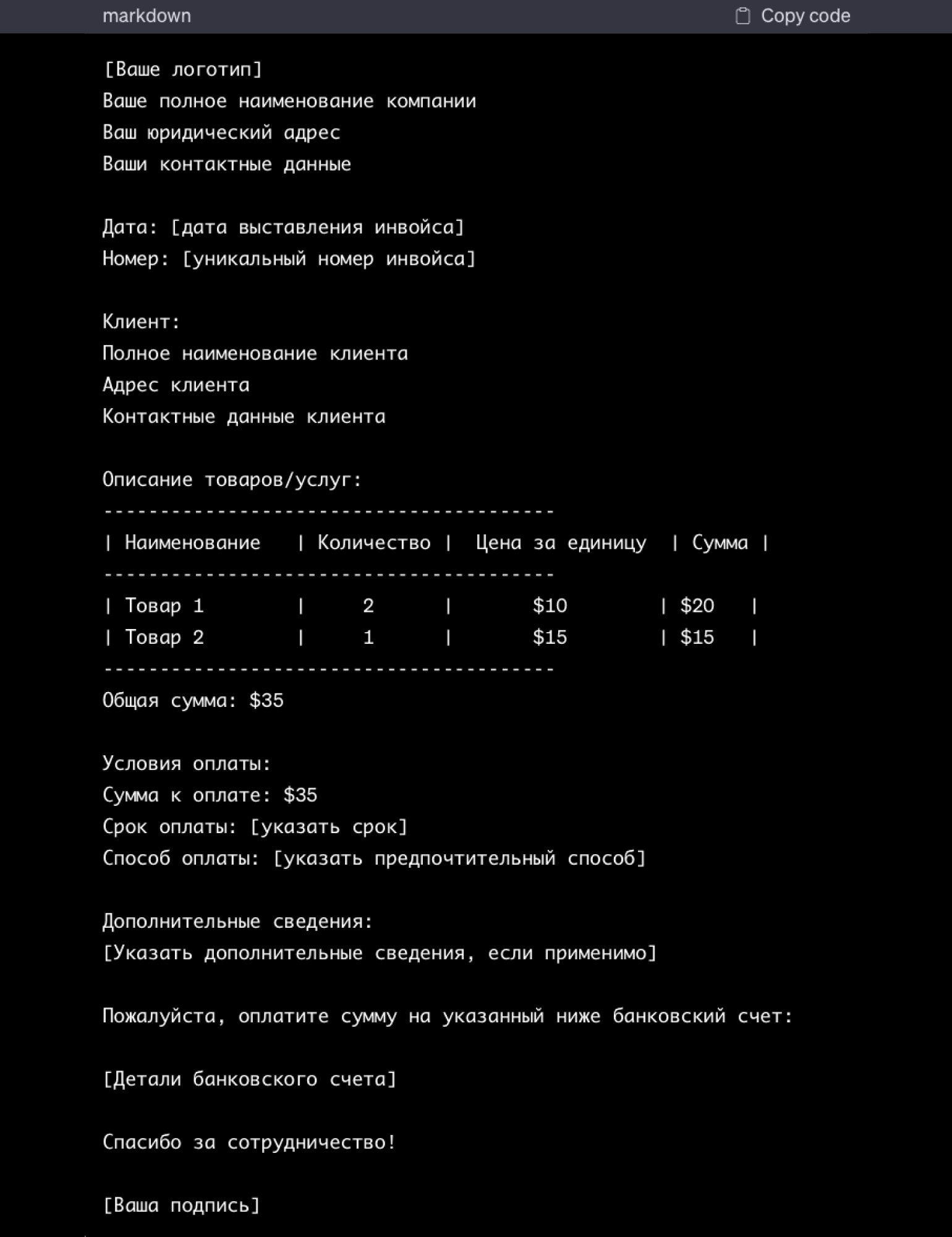
Примечание: этот пример инвойса представляет собой общий шаблон и может быть настроен в соответствии с требованиями вашего бизнеса. Обратитесь к профессиональному бухгалтеру или специалисту по финансам для получения конкретных рекомендаций и соблюдения правил вашей страны или региона.