Sorry, you have been blocked
This website is using a security service to protect itself from online attacks. The action you just performed triggered the security solution. There are several actions that could trigger this block including submitting a certain word or phrase, a SQL command or malformed data.
What can I do to resolve this?
You can email the site owner to let them know you were blocked. Please include what you were doing when this page came up and the Cloudflare Ray ID found at the bottom of this page.
Cloudflare Ray ID: 8195188be973b385 • Your IP: Click to reveal 45.84.122.38 • Performance & security by Cloudflare
Сердце эфириума: Что такое ETHEREUM VIRTUAL MACHINE (EVM)?
Ethereum произвел настоящую революцию в мире блокчейн-технологий. Bitcoin, блокчейн первого поколения, задумывался всего лишь как децентрализованная платежная система, позволившая проводить денежные транзакции без участия посредников. Ethereum, блокчейн второго поколения, уже предназначен для создания и исполнения полноценных смарт-контрактов, на основе которых строятся различные децентрализованные приложения (Dapps). Функционал блокчейна расширился настолько, что Ethereum стал популярной средой, где разработчики воплощают новые идеи.
И здесь на сцену выходит Ethereum Virtual Machine (EVM) – программная среда, в которой разворачиваются смарт-контракты и создаются Dapps. По сути, это глобальный децентрализованный компьютер со множеством нод (узлов), которые имеют собственные хранилища данных. Без EVM Ethereum не был бы тем блокчейном, который мы знаем сегодня.
В этой статье мы познакомимся со структурой EVM, разберем основные понятия, а также затронем преимущества и недостатки виртуальной машины.
EVM представляет собой т.н. «распределенную машину состояний» (distributed state machine), разработанную в 2015 году (создатель – Гэвин Вуд). В Ethereum состояние – это объемная структура данных, в которые включены все аккаунты и балансы счетов. EVM обновляет состояние сети при добавлении каждого нового блока. Процедура контролируется определенным набором правил, заданных самой EVM.
EVM (машина состояний) является квази-полной по Тьюрингу, т.е. фактически она способна выполнять любые вычисления, но со своими ограничениями (о которых поговорим в следующем разделе). Такие возможности появились благодаря оп-кодам (opcodes) – инструкциям EVM по выполнению конкретных операций, будь то арифметические операции, операции с блоками и пр. На сегодняшний день их насчитывается порядка 150.
Сами вычисления проводятся по достаточно длинной схеме. Сначала мы пишем код на определенном языке программирования, например Solidity (также создан Гэвином Вудом). Затем исходный код преобразуется в байт-код (последовательность символов в шестнадцатеричной системе), который разделяется на отдельные байты. В итоге вычислительные операции проводятся с помощью оп-кодов (каждому оп-коду приписывается один байт). Они работают с областями памяти, которые хранят данные и называются «стеками» (грубо говоря, это стопка элементов, в которой добавлять и удалять элементы можно лишь на ее вершине). Максимальный размер «стека» – 1024 элемента по 256 бит. В EVM есть также области памяти, в которых хранятся более сложные типы данных – contract memory (временное хранение) и storage (постоянное хранение).
Теперь представьте, что сеть должна обработать астрономическое количество наисложнейших операций. Она сильно замедлится, а может, даже и сломается!
Поскольку смарт-контракт предусматривает лишь ограниченное количество вычислительных операций, мы имеем дело с квази-тьюринг-полной системой (ее еще называют «конечным автоматом»). Расчетной единицей, которая измеряет вычислительные ресурсы и ресурсы хранилищ для выполнения операций, является газ. Его стоимость рассчитывается в эфирах и зависит от сложности операции, а также загруженности Ethereum.
Газ выполняет три функции. Во-первых, он выступает платежным средством, позволяющим проводить вычислительные операции, и вознаграждением для валидаторов, верифицирующих транзакции. В данном случае газ напоминает топливо, которое использует машина для передвижения из одной точки в другую.
Во-вторых, газ стимулирует разработчиков писать более лаконичный код. Чем он сложнее, тем больше нагрузка на сеть, которая обрабатывает его. Поэтому менее эффективный код будет иметь большую стоимость, и разработчики вынуждены сокращать ее.
В-третьих, газ обеспечивает безопасность сети. Без газа злоумышленники были бы способны запустить бесконечные циклы, которые застопорили бы работу сети. Именно поэтому блоки имеют лимит по количеству единиц газа и, соответственно, лимит по количеству транзакций. Если он превышает допустимую норму, блок попросту не примут.
Значение EVM невозможно переоценить. Она стала средой, подходящей для разработки смарт-контрактов, а они, в свою очередь, стали основой токенов стандарта ERC-20, NFT, DAOs (децентрализованные автономные организации) и Dapps, включая различные игры, DeFi-проекты и даже децентрализованные биржи (например, Uniswap)! К тому же, децентрализация системы гарантирует безопасность смарт-контрактов и децентрализованных приложений: нарушения в работе одной ноды (узла) не приостановит их функционирование.
И все же, виртуальная машина Ethereum обладает ощутимыми минусами. В частности, сеть страдает от высоких цен за проведение операций и хранение данных, а также низкой масштабируемости. Они сильно критикуются со стороны криптосообщества, хотя для решения этих проблем разрабатываются сайдчейны и L2-проекты (решения второго уровня).
В ближайшем времени EVM должен сменить улучшенный аналог машины – EWASM (Ethereum Web Assembly). Это станет частью масштабного перехода сети к Ethereum 2.0. EWASM позволит решить ряд проблем, повысив скорость сети, добавив новые языки программирования и пр. Скоро мы выясним, насколько EWASM станет эффективной заменой для популярной EVM.
Chapter 13: The Ethereum Virtual Machine
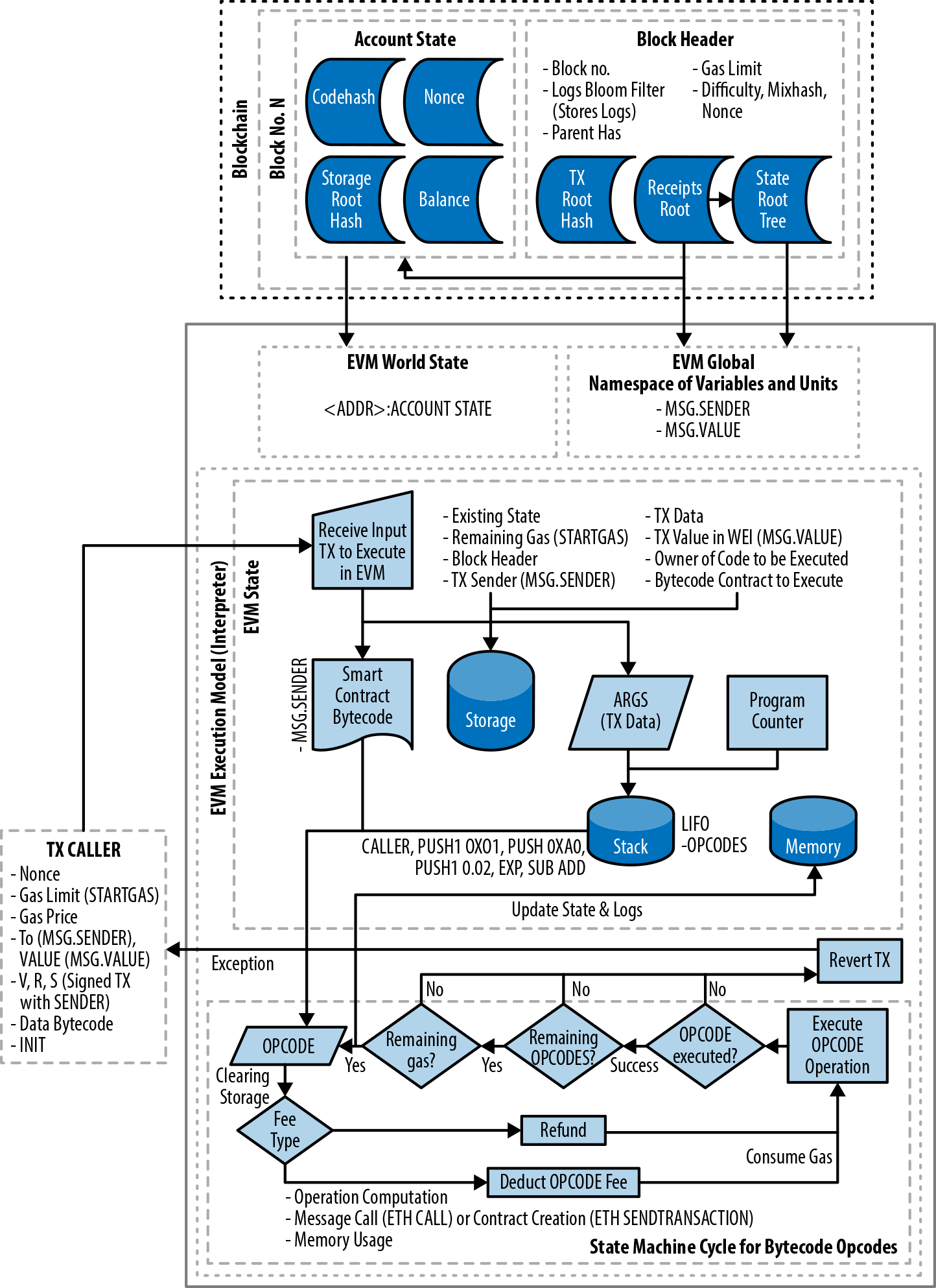
At the heart of the Ethereum protocol and operation is the Ethereum Virtual Machine, or EVM for short. As you might guess from the name, it is a computation engine, not hugely dissimilar to the virtual machines of Microsoft’s .NET Framework, or interpreters of other bytecode-compiled programming languages such as Java. In this chapter we take a detailed look at the EVM, including its instruction set, structure, and operation, within the context of Ethereum state updates.
What Is the EVM?
The EVM is the part of Ethereum that handles smart contract deployment and execution. Simple value transfer transactions from one EOA to another don’t need to involve it, practically speaking, but everything else will involve a state update computed by the EVM. At a high level, the EVM running on the Ethereum blockchain can be thought of as a global decentralized computer containing millions of executable objects, each with its own permanent data store.
The EVM is a quasi–Turing-complete state machine; "quasi" because all execution processes are limited to a finite number of computational steps by the amount of gas available for any given smart contract execution. As such, the halting problem is "solved" (all program executions will halt) and the situation where execution might (accidentally or maliciously) run forever, thus bringing the Ethereum platform to halt in its entirety, is avoided.
The EVM has a stack-based architecture, storing all in-memory values on a stack. It works with a word size of 256 bits (mainly to facilitate native hashing and elliptic curve operations) and has several addressable data components:
An immutable program code ROM, loaded with the bytecode of the smart contract to be executed
A volatile memory, with every location explicitly initialized to zero
A permanent storage that is part of the Ethereum state, also zero-initialized
There is also a set of environment variables and data that is available during execution. We will go through these in more detail later in this chapter.
Comparison with Existing Technology
The term "virtual machine" is often applied to the virtualization of a real computer, typically by a "hypervisor" such as VirtualBox or QEMU, or of an entire operating system instance, such as Linux’s KVM. These must provide a software abstraction, respectively, of actual hardware, and of system calls and other kernel functionality.
The EVM operates in a much more limited domain: it is just a computation engine, and as such provides an abstraction of just computation and storage, similar to the Java Virtual Machine (JVM) specification, for example. From a high-level viewpoint, the JVM is designed to provide a runtime environment that is agnostic of the underlying host OS or hardware, enabling compatibility across a wide variety of systems. High-level programming languages such as Java or Scala (which use the JVM) or C# (which uses .NET) are compiled into the bytecode instruction set of their respective virtual machine. In the same way, the EVM executes its own bytecode instruction set (described in the next section), which higher-level smart contract programming languages such as LLL, Serpent, Mutan, or Solidity are compiled into.
The EVM, therefore, has no scheduling capability, because execution ordering is organized externally to it—Ethereum clients run through verified block transactions to determine which smart contracts need executing and in which order. In this sense, the Ethereum world computer is single-threaded, like JavaScript. Neither does the EVM have any "system interface" handling or “hardware support”—there is no physical machine to interface with. The Ethereum world computer is completely virtual.
The EVM Instruction Set (Bytecode Operations)
The EVM instruction set offers most of the operations you might expect, including:
Arithmetic and bitwise logic operations
Execution context inquiries
Stack, memory, and storage access
Control flow operations
Logging, calling, and other operators
In addition to the typical bytecode operations, the EVM also has access to account information (e.g., address and balance) and block information (e.g., block number and current gas price).
Let’s start our exploration of the EVM in more detail by looking at the available opcodes and what they do. As you might expect, all operands are taken from the stack, and the result (where applicable) is often put back on the top of the stack.
A complete list of opcodes and their corresponding gas cost can be found in [evm_opcodes].
The available opcodes can be divided into the following categories:
Arithmetic opcode instructions:
Note that all arithmetic is performed modulo 2 256 (unless otherwise noted), and that the zeroth power of zero, 0 0 , is taken to be 1.
Stack, memory, and storage management instructions:
Instructions for control flow:
Opcodes for the system executing the program:
Opcodes for comparisons and bitwise logic:
Opcodes dealing with execution environment information:
Opcodes for accessing information on the current block:
Ethereum State
The job of the EVM is to update the Ethereum state by computing valid state transitions as a result of smart contract code execution, as defined by the Ethereum protocol. This aspect leads to the description of Ethereum as a transaction-based state machine, which reflects the fact that external actors (i.e., account holders and miners) initiate state transitions by creating, accepting, and ordering transactions. It is useful at this point to consider what constitutes the Ethereum state.
At the top level, we have the Ethereum world state. The world state is a mapping of Ethereum addresses (160-bit values) to accounts. At the lower level, each Ethereum address represents an account comprising an ether balance (stored as the number of wei owned by the account), a nonce (representing the number of transactions successfully sent from this account if it is an EOA, or the number of contracts created by it if it is a contract account), the account’s storage (which is a permanent data store, only used by smart contracts), and the account’s program code (again, only if the account is a smart contract account). An EOA will always have no code and an empty storage.
When a transaction results in smart contract code execution, an EVM is instantiated with all the information required in relation to the current block being created and the specific transaction being processed. In particular, the EVM’s program code ROM is loaded with the code of the contract account being called, the program counter is set to zero, the storage is loaded from the contract account’s storage, the memory is set to all zeros, and all the block and environment variables are set. A key variable is the gas supply for this execution, which is set to the amount of gas paid for by the sender at the start of the transaction (see Gas for more details). As code execution progresses, the gas supply is reduced according to the gas cost of the operations executed. If at any point the gas supply is reduced to zero we get an "Out of Gas" (OOG) exception; execution immediately halts and the transaction is abandoned. No changes to the Ethereum state are applied, except for the sender’s nonce being incremented and their ether balance going down to pay the block’s beneficiary for the resources used to execute the code to the halting point. At this point, you can think of the EVM running on a sandboxed copy of the Ethereum world state, with this sandboxed version being discarded completely if execution cannot complete for whatever reason. However, if execution does complete successfully, then the real-world state is updated to match the sandboxed version, including any changes to the called contract’s storage data, any new contracts created, and any ether balance transfers that were initiated.
Note that because a smart contract can itself effectively initiate transactions, code execution is a recursive process. A contract can call other contracts, with each call resulting in another EVM being instantiated around the new target of the call. Each instantiation has its sandbox world state initialized from the sandbox of the EVM at the level above. Each instantiation is also given a specified amount of gas for its gas supply (not exceeding the amount of gas remaining in the level above, of course), and so may itself halt with an exception due to being given too little gas to complete its execution. Again, in such cases, the sandbox state is discarded, and execution returns to the EVM at the level above.
Compiling Solidity to EVM Bytecode
Compiling a Solidity source file to EVM bytecode can be accomplished via several methods. In [intro_chapter] we used the online Remix compiler. In this chapter, we will use the solc executable at the command line. For a list of options, run the following command :
Generating the raw opcode stream of a Solidity source file is easily achieved with the —opcodes command-line option. This opcode stream leaves out some information (the —asm option produces the full information), but it is sufficient for this discussion. For example, compiling an example Solidity file, Example.sol, and sending the opcode output into a directory named BytecodeDir is accomplished with the following command:
The following command will produce the bytecode binary for our example program:
The output opcode files generated will depend on the specific contracts contained within the Solidity source file. Our simple Solidity file Example.sol has only one contract, named example:
As you can see, all this contract does is hold one persistent state variable, which is set as the address of the last account to run this contract.
If you look in the BytecodeDir directory you will see the opcode file example.opcode, which contains the EVM opcode instructions of the example contract. Opening the example.opcode file in a text editor will show the following:
Compiling the example with the —asm option produces a file named example.evm in our BytecodeDir directory. This contains a slightly higher-level description of the EVM bytecode instructions, together with some helpful annotations:
The —bin-runtime option produces the machine-readable hexadecimal bytecode:
You can investigate what’s going on here in detail using the opcode list given in The EVM Instruction Set (Bytecode Operations). However, that’s quite a task, so let’s just start by examining the first four instructions:
Here we have PUSH1 followed by a raw byte of value 0x60. This EVM instruction takes the single byte following the opcode in the program code (as a literal value) and pushes it onto the stack. It is possible to push values of size up to 32 bytes onto the stack, as in:
The second PUSH1 opcode from example.opcode stores 0x40 onto the top of the stack (pushing the 0x60 already present there down one slot).
Next is MSTORE, which is a memory store operation that saves a value to the EVM’s memory. It takes two arguments and, like most EVM operations, obtains them from the stack. For each argument the stack is “popped”; i.e., the top value on the stack is taken off and all the other values on the stack are shifted up one position. The first argument for MSTORE is the address of the word in memory where the value to be saved will be put. For this program we have 0x40 at the top of the stack, so that is removed from the stack and used as the memory address. The second argument is the value to be saved, which is 0x60 here. After the MSTORE operation is executed our stack is empty again, but we have the value 0x60 (96 in decimal) at the memory location 0x40.
The next opcode is CALLVALUE, which is an environmental opcode that pushes onto the top of the stack the amount of ether (measured in wei) sent with the message call that initiated this execution.
We could continue to step through this program in this way until we had a full understanding of the low-level state changes that this code effects, but it wouldn’t help us at this stage. We’ll come back to it later in the chapter.
Contract Deployment Code
There is an important but subtle difference between the code used when creating and deploying a new contract on the Ethereum platform and the code of the contract itself. In order to create a new contract, a special transaction is needed that has its to field set to the special 0x0 address and its data field set to the contract’s initiation code. When such a contract creation transaction is processed, the code for the new contract account is not the code in the data field of the transaction. Instead, an EVM is instantiated with the code in the data field of the transaction loaded into its program code ROM, and then the output of the execution of that deployment code is taken as the code for the new contract account. This is so that new contracts can be programmatically initialized using the Ethereum world state at the time of deployment, setting values in the contract’s storage and even sending ether or creating further new contracts.
When compiling a contract offline, e.g., using solc on the command line, you can either get the deployment bytecode or the runtime bytecode.
The deployment bytecode is used for every aspect of the initialization of a new contract account, including the bytecode that will actually end up being executed when transactions call this new contract (i.e., the runtime bytecode) and the code to initialize everything based on the contract’s constructor.
The runtime bytecode, on the other hand, is exactly the bytecode that ends up being executed when the new contract is called, and nothing more; it does not include the bytecode needed to initialize the contract during deployment.
Let’s take the simple Faucet.sol contract we created earlier as an example:
To get the deployment bytecode, we would run solc —bin Faucet.sol . If we instead wanted just the runtime bytecode, we would run solc —bin-runtime Faucet.sol .
If you compare the output of these commands, you will see that the runtime bytecode is a subset of the deployment bytecode. In other words, the runtime bytecode is entirely contained within the deployment bytecode.
Disassembling the Bytecode
Disassembling EVM bytecode is a great way to understand how high-level Solidity acts in the EVM. There are a few disassemblers you can use to do this:
Porosity is a popular open source decompiler.
Ethersplay is an EVM plug-in for Binary Ninja, a disassembler.
IDA-Evm is an EVM plugin for IDA, another disassembler.
In this section, we will be using the Ethersplay plug-in for Binary Ninja and to start Disassembling the Faucet runtime bytecode. After getting the runtime bytecode of Faucet.sol, we can feed it into Binary Ninja (after loading the Ethersplay plug-in) to see what the EVM instructions look like.
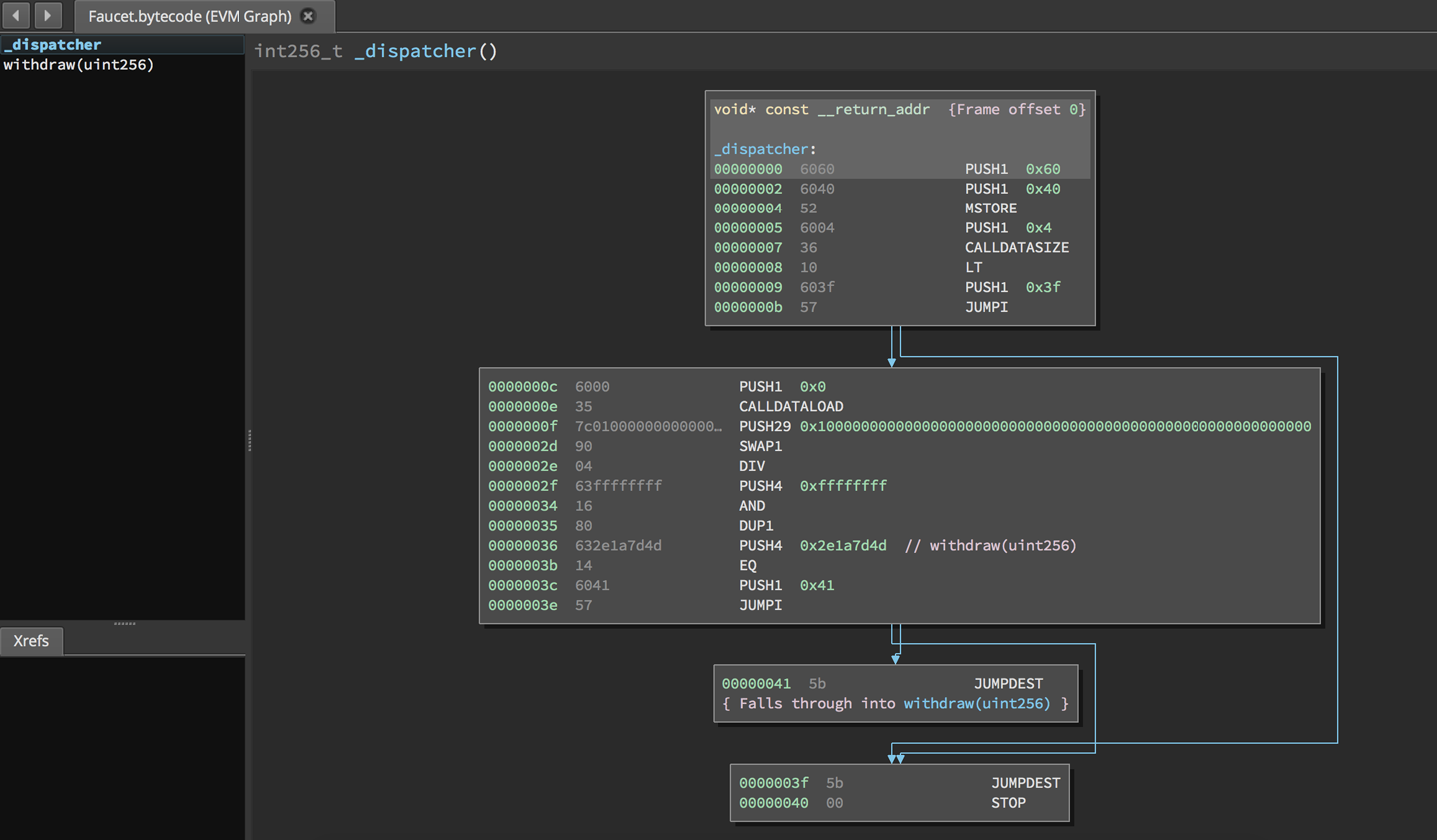
When you send a transaction to an ABI-compatible smart contract (which you can assume all contracts are), the transaction first interacts with that smart contract’s dispatcher. The dispatcher reads in the data field of the transaction and sends the relevant part to the appropriate function. We can see an example of a dispatcher at the beginning of our disassembled Faucet.sol runtime bytecode. After the familiar MSTORE instruction, we see the following instructions:
As we have seen, PUSH1 0x4 places 0x4 onto the top of the stack, which is otherwise empty. CALLDATASIZE gets the size in bytes of the data sent with the transaction (known as the calldata) and pushes that number onto the stack. After these operations have been executed, the stack looks like this:
<length of calldata from tx>
This next instruction is LT, short for “less than.” The LT instruction checks whether the top item on the stack is less than the next item on the stack. In our case, it checks to see if the result of CALLDATASIZE is less than 4 bytes.
Why does the EVM check to see that the calldata of the transaction is at least 4 bytes? Because of how function identifiers work. Each function is identified by the first 4 bytes of its Keccak-256 hash. By placing the function’s name and what arguments it takes into a keccak256 hash function, we can deduce its function identifier. In our case, we have:
Thus, the function identifier for the withdraw(uint256) function is 0x2e1a7d4d, since these are the first 4 bytes of the resulting hash. A function identifier is always 4 bytes long, so if the entire data field of the transaction sent to the contract is less than 4 bytes, then there’s no function with which the transaction could possibly be communicating, unless a fallback function is defined. Because we implemented such a fallback function in Faucet.sol, the EVM jumps to this function when the calldata’s length is less than 4 bytes.
LT pops the top two values off the stack and, if the transaction’s data field is less than 4 bytes, pushes 1 onto it. Otherwise, it pushes 0. In our example, let’s assume the data field of the transaction sent to our contract was less than 4 bytes.
The PUSH1 0x3f instruction pushes the byte 0x3f onto the stack. After this instruction, the stack looks like this:
The next instruction is JUMPI, which stands for "jump if." It works like so:
In our case, label is 0x3f, which is where our fallback function lives in our smart contract. The cond argument is 1, which was the result of the LT instruction earlier. To put this entire sequence into words, the contract jumps to the fallback function if the transaction data is less than 4 bytes.
At 0x3f, only a STOP instruction follows, because although we declared a fallback function, we kept it empty. As you can see in JUMPI instruction leading to fallback function, had we not implemented a fallback function, the contract would throw an exception instead.
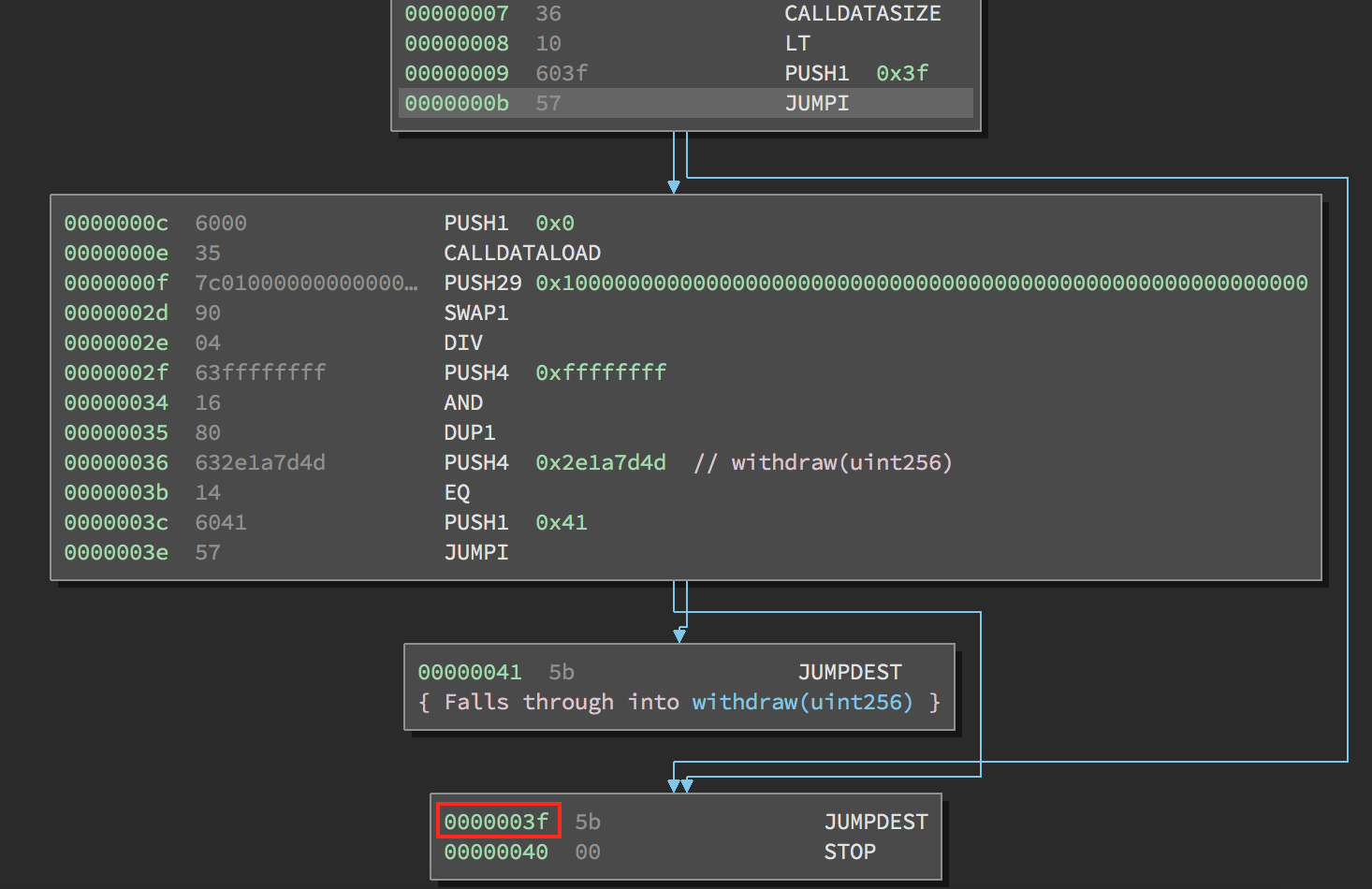
Let’s examine the central block of the dispatcher. Assuming we received calldata that was greater than 4 bytes in length, the JUMPI instruction would not jump to the fallback function. Instead, code execution would proceed to the following instructions:
PUSH1 0x0 pushes 0 onto the stack, which is now otherwise empty again. CALLDATALOAD accepts as an argument an index within the calldata sent to the smart contract and reads 32 bytes from that index, like so:
Since 0 was the index passed to it from the PUSH1 0x0 command, CALLDATALOAD reads 32 bytes of calldata starting at byte 0, and then pushes it to the top of the stack (after popping the original 0x0). After the PUSH29 0x1000000… instruction, the stack is then:
<32 bytes of calldata starting at byte 0>
0x1000000… (29 bytes in length)
SWAP1 switches the top element on the stack with the i-th element after it. In this case, it swaps 0x1000000… with the calldata. The new stack is:
0x1000000… (29 bytes in length)
<32 bytes of calldata starting at byte 0>
The next instruction is DIV, which works as follows:
In this case, x = 32 bytes of calldata starting at byte 0, and y = 0x100000000… (29 bytes total). Can you think of why the dispatcher is doing the division? Here’s a hint: we read 32 bytes from calldata earlier, starting at index 0. The first 4 bytes of that calldata is the function identifier.
The 0x100000000… we pushed earlier is 29 bytes long, consisting of a 1 at the beginning, followed by all 0s. Dividing our 32 bytes of calldata by this value will leave us only the topmost 4 bytes of our calldata load, starting at index 0. These 4 bytes—the first 4 bytes in the calldata starting at index 0—are the function identifier, and this is how the EVM extracts that field.
If this part isn’t clear to you, think of it like this: in base 10, 1234000 / 1000 = 1234. In base 16, this is no different. Instead of every place being a multiple of 10, it is a multiple of 16. Just as dividing by 10 3 (1000) in our smaller example kept only the topmost digits, dividing our 32-byte base 16 value by 16 29 does the same.
The result of the DIV (the function identifier) gets pushed onto the stack, and our stack is now:
<function identifier sent in data>
Since the PUSH4 0xffffffff and AND instructions are redundant, we can ignore them entirely, as the stack will remain the same after they are done. The DUP1 instruction duplicates the first item on the stack, which is the function identifier. The next instruction, PUSH4 0x2e1a7d4d, pushes the precalculated function identifier of the withdraw(uint256) function onto the stack. The stack is now:
<function identifier sent in data>
<function identifier sent in data>
The next instruction, EQ, pops off the top two items of the stack and compares them. This is where the dispatcher does its main job: it compares whether the function identifier sent in the msg.data field of the transaction matches that of withdraw(uint256) . If they are equal, EQ pushes 1 onto the stack, which will ultimately be used to jump to the withdraw function. Otherwise, EQ pushes 0 onto the stack.
Assuming the transaction sent to our contract indeed began with the function identifier for withdraw(uint256), our stack has become:
<function identifier sent in data> (now known to be 0x2e1a7d4d)
Next, we have PUSH1 0x41, which is the address at which the withdraw(uint256) function lives in the contract. After this instruction, the stack looks like this:
function identifier sent in msg.data
The JUMPI instruction is next, and it once again accepts the top two elements on the stack as arguments. In this case, we have jumpi(0x41, 1), which tells the EVM to execute the jump to the location of the withdraw(uint256) function, and the execution of that function’s code can proceed.
Turing Completeness and Gas
As we have already touched on, in simple terms, a system or programming language is Turing complete if it can run any program. This capability, however, comes with an very important caveat: some programs take forever to run. An important aspect of this is that we can’t tell, just by looking at a program, whether it will take forever or not to execute. We have to actually go through with the execution of the program and wait for it to finish to find out. Of course, if it is going to take forever to execute, we will have to wait forever to find out. This is called the halting problem and would be a huge problem for Ethereum if it were not addressed.
Because of the halting problem, the Ethereum world computer is at risk of being asked to execute a program that never stops. This could be by accident or malice. We have discussed that Ethereum acts like a single-threaded machine, without any scheduler, and so if it became stuck in an infinite loop this would mean it would become unusable.
However, with gas, there is a solution: if after a prespecified maximum amount of computation has been performed, the execution hasn’t ended, the execution of the program is halted by the EVM. This makes the EVM a quasi–Turing-complete machine: it can run any program you feed into it, but only if the program terminates within a particular amount of computation. That limit isn’t fixed in Ethereum—you can pay to increase it up to a maximum (called the "block gas limit"), and everyone can agree to increase that maximum over time. Nevertheless, at any one time, there is a limit in place, and transactions that consume too much gas while executing are halted .
In the following sections, we will look at gas and examine how it works in detail.
Gas is Ethereum’s unit for measuring the computational and storage resources required to perform actions on the Ethereum blockchain. In contrast to Bitcoin, whose transaction fees only take into account the size of a transaction in kilobytes, Ethereum must account for every computational step performed by transactions and smart contract code execution.
Each operation performed by a transaction or contract costs a fixed amount of gas. Some examples, from the Ethereum Yellow Paper:
Adding two numbers costs 3 gas
Calculating a Keccak-256 hash costs 30 gas + 6 gas for each 256 bits of data being hashed
Sending a transaction costs 21,000 gas
Gas is a crucial component of Ethereum, and serves a dual role: as a buffer between the (volatile) price of Ethereum and the reward to miners for the work they do, and as a defense against denial-of-service attacks. To prevent accidental or malicious infinite loops or other computational wastage in the network, the initiator of each transaction is required to set a limit to the amount of computation they are willing to pay for. The gas system thereby disincentivizes attackers from sending "spam" transactions, as they must pay proportionately for the computational, bandwidth, and storage resources that they consume.
Gas Accounting During Execution
When an EVM is needed to complete a transaction, in the first instance it is given a gas supply equal to the amount specified by the gas limit in the transaction. Every opcode that is executed has a cost in gas, and so the EVM’s gas supply is reduced as the EVM steps through the program. Before each operation, the EVM checks that there is enough gas to pay for the operation’s execution. If there isn’t enough gas, execution is halted and the transaction is reverted.
If the EVM reaches the end of execution successfully, without running out of gas, the gas cost used is paid to the miner as a transaction fee, converted to ether based on the gas price specified in the transaction:
The gas remaining in the gas supply is refunded to the sender, again converted to ether based on the gas price specified in the transaction:
If the transaction “runs out of gas” during execution, the operation is immediately terminated, raising an “out of gas” exception. The transaction is reverted and all changes to the state are rolled back.
Although the transaction was unsuccessful, the sender will be charged a transaction fee, as miners have already performed the computational work up to that point and must be compensated for doing so.
Gas Accounting Considerations
The relative gas costs of the various operations that can be performed by the EVM have been carefully chosen to best protect the Ethereum blockchain from attack. You can see a detailed table of gas costs for different EVM opcodes in [evm_opcodes_table].
More computationally intensive operations cost more gas. For example, executing the SHA3 function is 10 times more expensive (30 gas) than the ADD operation (3 gas). More importantly, some operations, such as EXP, require an additional payment based on the size of the operand. There is also a gas cost to using EVM memory and for storing data in a contract’s on-chain storage.
The importance of matching gas cost to the real-world cost of resources was demonstrated in 2016 when an attacker found and exploited a mismatch in costs. The attack generated transactions that were very computationally expensive, and made the Ethereum mainnet almost grind to a halt. This mismatch was resolved by a hard fork (codenamed "Tangerine Whistle") that tweaked the relative gas costs.
Gas Cost Versus Gas Price
While the gas cost is a measure of computation and storage used in the EVM, the gas itself also has a price measured in ether. When performing a transaction, the sender specifies the gas price they are willing to pay (in ether) for each unit of gas, allowing the market to decide the relationship between the price of ether and the cost of computing operations (as measured in gas):
When constructing a new block, miners on the Ethereum network can choose among pending transactions by selecting those that offer to pay a higher gas price. Offering a higher gas price will therefore incentivize miners to include your transaction and get it confirmed faster.
In practice, the sender of a transaction will set a gas limit that is higher than or equal to the amount of gas expected to be used. If the gas limit is set higher than the amount of gas consumed, the sender will receive a refund of the excess amount, as miners are only compensated for the work they actually perform.
It is important to be clear about the distinction between the gas cost and the gas price. To recap:
Gas cost is the number of units of gas required to perform a particular operation.
Gas price is the amount of ether you are willing to pay per unit of gas when you send your transaction to the Ethereum network.
While gas has a price, it cannot be "owned" nor "spent." Gas exists only inside the EVM, as a count of how much computational work is being performed. The sender is charged a transaction fee in ether, which is then converted to gas for EVM accounting and then back to ether as a transaction fee paid to the miners.
Negative gas costs
Ethereum encourages the deletion of used storage variables and accounts by refunding some of the gas used during contract execution.
There are two operations in the EVM with negative gas costs:
Deleting a contract (SELFDESTRUCT) is worth a refund of 24,000 gas.
Changing a storage address from a nonzero value to zero (SSTORE[x] = 0) is worth a refund of 15,000 gas.
To avoid exploitation of the refund mechanism, the maximum refund for a transaction is set to half the total amount of gas used (rounded down).
Block Gas Limit
The block gas limit is the maximum amount of gas that may be consumed by all the transactions in a block, and constrains how many transactions can fit into a block.
For example, let’s say we have 5 transactions whose gas limits have been set to 30,000, 30,000, 40,000, 50,000, and 50,000. If the block gas limit is 180,000, then any four of those transactions can fit in a block, while the fifth will have to wait for a future block. As previously discussed, miners decide which transactions to include in a block. Different miners are likely to select different combinations, mainly because they receive transactions from the network in a different order.
If a miner tries to include a transaction that requires more gas than the current block gas limit, the block will be rejected by the network. Most Ethereum clients will stop you from issuing such a transaction by giving a warning along the lines of “transaction exceeds block gas limit.” The block gas limit on the Ethereum mainnet is 8 million gas at the time of writing according to https://etherscan.io, meaning that around 380 basic transactions (each consuming 21,000 gas) could fit into a block.
Who decides what the block gas limit is?
The miners on the network collectively decide the block gas limit. Individuals who want to mine on the Ethereum network use a mining program, such as Ethminer, which connects to a Geth or Parity Ethereum client. The Ethereum protocol has a built-in mechanism where miners can vote on the gas limit so capacity can be increased or decreased in subsequent blocks. The miner of a block can vote to adjust the block gas limit by a factor of 1/1,024 (0.0976%) in either direction. The result of this is an adjustable block size based on the needs of the network at the time. This mechanism is coupled with a default mining strategy where miners vote on a gas limit that is at least 4.7 million gas, but which targets a value of 150% of the average of recent total gas usage per block (using a 1,024-block exponential moving average).
Conclusions
In this chapter we have explored the Ethereum Virtual Machine, tracing the execution of various smart contracts and looking at how the EVM executes bytecode. We also looked at gas, the EVM’s accounting mechanism, and saw how it solves the halting problem and protects Ethereum from denial-of-service attacks. Next, in [consensus], we will look at the mechanism used by Ethereum to achieve decentralized consensus.
EVM — определение масштаба
Другими словами, виртуальная машина Ethereum — это вычислительный механизм и программная платформа, функционирующая как децентрализованный компьютер. Разработчики используют виртуальную машину Ethereum для создания DApps на базе Ethereum и совместимого с EVM языка программирования Solidity — от криптоприложений DeFi и EVM до игр и торговых площадок, таких как OpenSea.
Самое главное, что виртуальная машина Ethereum — это часть сети Ethereum, отвечающая за исполнение и развертывание смарт-контрактов. Именно здесь живут и дышат смарт-контракты и миллионы DApps, основанных на блокчейне Ethereum.
Блокчейн Ethereum представляет собой P2P-структуру, состоящую из различных отдельных узлов. Один узел соединяется со следующим, в результате чего каждый узел отвечает за безопасность и стабильность всей экосистемы. Для этого и поддержания консенсуса во всем блокчейне Ethereum каждый узел использует EVM.
Чтобы еще больше прояснить концепцию EVM, следует вернуться к основам и вспомнить, как работают компьютерные программы. Все программы написаны на языке программирования, например Java или C++. Однако, поскольку процессоры не могут читать Java или C++, код компилируется и переводится в байткод.
Ethereum не является процессором — это распределенная всемирная сеть, в которой 100 процессоров одновременно работают с EVM. Однако EVM функционирует как виртуальный процессор или виртуальная «машина», запущенная внутри программы Go Ethereum, или «Geth».
По аналогии Apps и пишут смарт-контракты на языке программирования. Вмдобно другим программам, разработчики создают DApps и пишут смарт-контракты на языке программирования. или C++ язык для Ethereum называется Solidity. Код Solidity компилируется в байткод и распространяется на каждый компьютер (узел), работающий под управлением Geth в сети.
При развертывании смарт-контракта каждый узел получает его копию, выполняет его байткод и отдает код тому, кто вызвал развертывание, что приводит к «изменению состояния». Это означает, что текущее состояние блокчейна было изменено, что может быть сделано только при консенсусе всех узлов.
Поэтому EVM часто называют «распределенной машиной состояний». Она отслеживает состояние блокчейна по мере его трансформации при каждой транзакции.
Назначение EVM
Виртуальная машина Ethereum (EVM) — это полная программируемая машина Тьюринга, которая может выполнять сценарии для получения произвольных результатов. Она была создана с целью стать «мировым компьютером» и обладает огромной мощностью.
Основные идеи, лежащие в основе EVM:
хранит данные на блокчейне и выполняет код в смарт-контрактах в сети Ethereum.
запускать любые криптоконтракты, которые могут быть построены на блокчейне Ethereum, с помощью языка программирования Solidity, который компилируется в EVM для исполнения.
Как работает EVM?
Виртуальная машина Ethereum обеспечивает правильное и ожидаемое выполнение всех транзакций и смарт-контрактов, заключенных на блокчейне Ethereum, в соответствии с требованиями кода смарт-контракта. Она служит платформой для выполнения приложений.
Виртуальные машины, такие как EVM, функционируют аналогично физическим машинам с процессорами, памятью и хранилищами, но в них нет ничего, кроме кода. Теоретически виртуальную машину может запустить любой желающий, что придает ей гибкость и мобильность, необходимые децентрализованным сетям.
Виртуальная машина Ethereum использует децентрализованную узловую сеть для выполнения смарт-контрактов. Это динамический виртуальный стек с песочницей, встроенный в каждый узел Ethereum для выполнения байткода смарт-контрактов, совместимого с EVM.
Smart Contracts, Nodes and P2P
Каждый узел в сети Ethereum должен согласовывать свои действия со следующим узлом, чтобы выполнить одну и ту же инструкцию. Это делает виртуальную машину Ethereum Turing Complete, то есть она может выполнять логические шаги для вычислительной функции.
Каждой инструкции, реализуемой EVM, присваивается стоимость, что позволяет системе отслеживать затраты на ее выполнение. Стоимость совершения криптотранзакций EVM и выполнения других инструкций измеряется в EVM-совместимых единицах, называемых газом.
Благодаря тому, что экономика, как в биткойне, основана на оплате за выполненные инструкции, а не за проведенные финансовые транзакции, достигается Тьюринговая полнота. Это означает, что виртуальная машина Ethereum представляет собой одноранговый компьютер с глобальной связью, способный создавать смарт-контракты, краудфандинговые мероприятия P2P, файлообменные экономики и многое другое.
Опкоды
В настоящее время существует около 150 различных опкодов, которые может выполнять EVM. Так что же такое опкоды и почему они важны для понимания EVM?
Причина, по которой виртуальную машину Ethereum называют Turing Complete, во многом заключается в ее способности выполнять инструкции машинного уровня, известные как опкоды.
Опкоды, совместимые с EVM, помогают EVM выполнять определенные задачи, связанные с криптовалютными транзакциями EVM или смарт-контрактами. Однако опкоды используются для множества операций — от арифметики и регистрации данных до работы с памятью и извлечения информации о блоке.
Каждому опкоду отводится один байт. Таким образом, может быть использовано не более 256 опкодов.
Смарт-контракты
Каждый смарт-контракт содержит определенный перечень операций, которые должны быть выполнены при выполнении определенных условий на цепи или вне ее. Эти операции могут варьироваться от перевода средств на определенные адреса до создания новых смарт-контрактов и взаимодействия между существующими. Вместо того чтобы прибегать к услугам третьей стороны, любой человек может отправить средства на адрес смарт-контракта, чтобы инициировать эти операции.
Ethereum взял за основу концепцию Bitcoin и усилил ее, позволив разработчикам создавать смарт-контракты поверх своего блокчейна. Следующим шагом стало создание среды, в которой смарт-контракты могли бы жить и взаимодействовать друг с другом. Именно здесь в игру вступает виртуальная машина Ethereum.
EVM объединяет ресурсы не одного, а тысяч процессоров, подключенных к сети Ethereum. Помимо проверки транзакций, она транслирует опкод смарт-контрактов, написанный на языке Solidity, в байткод, что позволяет считывать инструкции и выполнять операции. Для последней части вам нужен газ.
Gas — это топливо, на котором работает виртуальная машина Ethereum. Переводите ли вы криптовалюту EVM или инвестируете в NFT, газ необходим для оплаты выполнения операции. Газ выступает в качестве платы за вычисления, необходимые для выполнения смарт-контрактов.
Каждому опкоду присваивается стоимость газа. Чем сложнее опкод, тем выше стоимость газа. В настоящее время начальная стоимость каждой операции составляет 21 000 газа.
Плата за газ взимается для компенсации валидаторов, ответственных за проверку достоверности информации о транзакции и отсутствие исключений или ошибок в EVM.
Что еще более важно, плата за газ помогает предотвращать DDoS-атаки и обеспечивать безопасность сети. Поскольку развертывание сложных контрактов в масштабах сети потребовало бы длительных и дорогостоящих вычислений, злоумышленники получают денежный стимул к тому, чтобы не предпринимать никаких злонамеренных попыток. Атака просто будет слишком дорогостоящей.
Что происходит в деталях
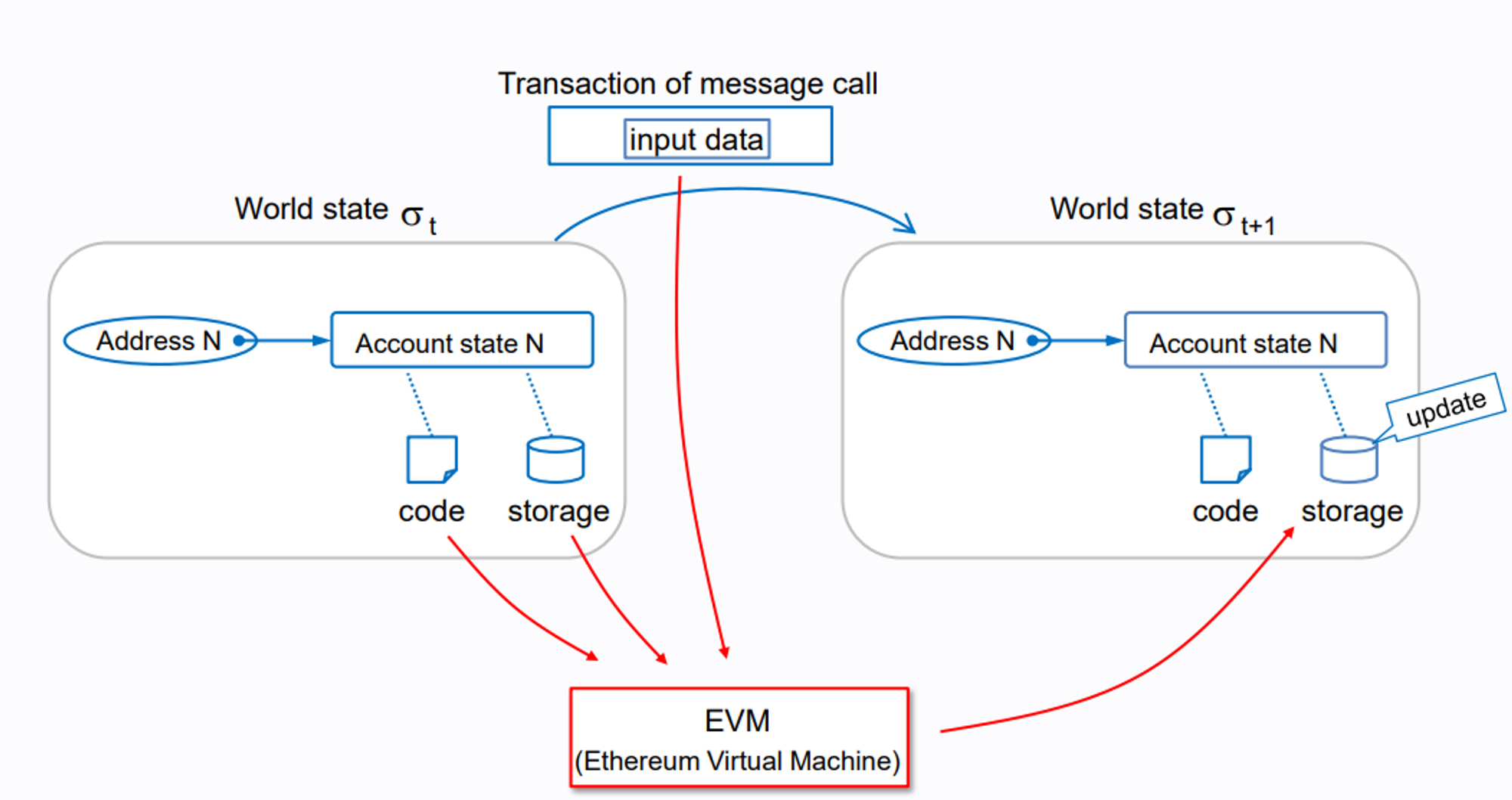
Данный рисунок описывает весь процесс совершения сделки. По шагам:
Первоначально мы имеем состояние мира t, а в некоторых блоках — транзакцию.
EVM обрабатывает это выполнение и выдает мировое состояние t+1.
Этот переход изменяет хранение некоторых счетов по транзакциям.
Блокчейн, совместимый с EVM
Взаимодействие между блокчейнами оказалось серьезной проблемой. Поскольку проблемы с Ethereum, такие как высокая плата за бензин и медленные транзакции, сохранялись, разработчики начали создавать DApps и смарт-контракты на основе других блокчейнов без права доступа, чтобы предложить более быстрые транзакции и более низкую плату за бензин. К сожалению, многие из этих блокчейнов сильно ограничены и не совместимы с другими блокчейнами.
Блокчейн, совместимый с EVM, оказался простым способом решения этой проблемы. Вместо того чтобы начинать с нуля и создавать среду, аналогичную EVM, с помощью межцепочечных мостов, разработчики могут скопировать некоторые элементы сети Ethereum и создать DApps, позволяющие пользователям быстро и легко переводить активы между любыми сетями EVM.
Техническое задание
О технических особенностях EVM можно рассказать очень много. В следующих статьях мы подробно рассмотрим опкоды, а также техническую сторону EVM.
Заключение
Мы обсудили некоторые общие аспекты EVM. А также ответили на три больших вопроса: что, зачем и как. Цель этой статьи — дать вам просто введение в EVM. Следующие статьи будут более техническими, мы обсудим опкоды и то, как именно работает EVM внутри.