Sorry, you have been blocked
This website is using a security service to protect itself from online attacks. The action you just performed triggered the security solution. There are several actions that could trigger this block including submitting a certain word or phrase, a SQL command or malformed data.
What can I do to resolve this?
You can email the site owner to let them know you were blocked. Please include what you were doing when this page came up and the Cloudflare Ray ID found at the bottom of this page.
Cloudflare Ray ID: 81942379c9b0b347 • Your IP: Click to reveal 45.84.122.38 • Performance & security by Cloudflare
Разбираемся в снепшотах в контексте криптовалют
Снепшот (Snapshot) — это документирование состояния блокчейна на определенной отметке высоты блока.
Что такое снепшот?
Способность записывать состояние чего-либо в точный момент времени называется снапшотом. В мире блокчейна снапшот — это акт документирования состояния блокчейна на определенной высоте блока. Его используют для отслеживания общего количества и баланса держателей токенов в любой момент времени.
Традиционная интерпретация.
Получение снапшота, также известного как снапшот хранилища, аналогично фотографированию данных вашего сервера в определенный момент времени. Снапшоты не являются полным дубликатом данных на жестком диске; по большей части они представляют собой метаданные, определяющие состояние информации. Кроме того, они могут быть сохранены только на локальном сервере или устройстве, где они были созданы.
Так как при тестировании приложений живые данные, например, при тестировании нового приложения или программы или опробовании новых настроек, могут подвергнуть вашу систему риску, для test/dev обычно используются снапшоты. Они предоставляют доступ к бесконечному количеству клонов ваших данных, что дает вам возможность работать над разработкой без ущерба для вашей обычной работы. Автоматизация, тестирование, итерации и демонтаж рабочих процессов не занимают много дополнительного места в хранилище. При возникновении ошибки можно откатить сервер к более ранней точке.
Полное резервное копирование может занимать несколько часов, а в некоторых случаях его приходится делать в течение ночи, поскольку оно требует больших системных ресурсов. А вот моментальные снимки могут быть созданы за несколько секунд и так часто, как это необходимо. Кроме того, можно дедуплицировать данные, создаваемые с помощью моментальных снимков, используя такие технологии, как отслеживание модифицированных блоков (CBT).
Снапшоты предназначены для хранения только в течение ограниченного периода времени, но при неправильной работе они могут привести к невероятно сложным цепочкам данных и очень длительному времени консолидации.
Криптографические снепшоты.
Снапшот в криптовалюте — это протокол состояния блокчейна на определенной высоте блока. Он фиксирует весь блокчейн, включая все существующие адреса и связанные с ними данные.
Что такое снепшоты в криптовалютных эйрдроп-событиях?
Перед проведением каждого раунда события airdrop часто делаются моментальные снимки. Распределение токенов происходит на основе баланса каждого адреса блокчейна, доступного в период моментального снимка. Снимки делаются для того, чтобы зафиксировать баланс каждого держателя токенов в определенный момент времени (т.е. высоту блока). Пользователи обычно могут перемещать свои средства после получения моментального снимка, не ставя под угрозу свое право на участие в данном раунде выплат.
What is Snapshot? The role of Snapshot in the Cryptocurrency Market

If you are one of the active members in communities, you must be no stranger to Snapshot — one of the fairest and fee-less voting platforms. Currently, Snapshot is favored by many major projects and decentralized autonomous organizations (DAOs). So, where did it originate from, and what features have made Snapshot so popular? Let’s explore this in the following article.
1. What is Snapshot?
Snapshot is a voting platform that enables decentralized autonomous organizations (DAOs), DeFi protocols, and NFT communities to conduct free and easy voting. Organizations can utilize these voting mechanisms to gauge user opinions. Essentially, Snapshot can be understood as an off-chain multi-governance solution that eliminates the need for gas fees.
The application allows users/organizations to create spaces, propose or participate in governance activities for an organization. The flexible voting strategies can be customized, and its open-source nature has contributed to Snapshot becoming a widely adopted product.
Currently, the Snapshot website displays over 21,000 spaces representing various organizations, DAOs, and protocols across different fields. Notable top DeFi protocols included in these spaces are Aave, Uniswap, Pancake, Sushi…
2. The products of Snapshot
Snapshot offers the following products/features:
- Spaces
- Proposal
- Voting
- Voting Strategies
- Plugins
2.1. Spaces
Snapshot Spaces are the designated areas within the system, serving as the accounts for organizations/projects on Snapshot. Spaces support user linkage through non-custodial wallets like Metamask, WalletConnect, and others.
- To create spaces, users/organizations need to have an ENS (Ethereum Name Service) domain for registration.
- Completing the space profile involves providing a name for the DAO and filling in relevant information, such as a profile picture and a description of the field in which your DAO operates.
- Spaces allow users/organizations to manage members, customize settings, propose, and vote on relevant information.
In the “Explore” section of Spaces, users can search for the names and categorize organizations/projects based on various categories or corresponding chains (Ethereum Mainnet, Polygon Mainnet, etc.). Once users access the desired project, they can read information about the project, vote on different topics, and see the percentage of users who have voted on each topic.
2.2. Proposal
Proposal in Snapshot is a feature that allows users to submit suggestions or proposals related to a specific organization and enables eligible users to participate in voting.
- This feature allows users to create proposals in any permitted project space, but there are limitations as some spaces may require users to meet certain conditions before being eligible to participate. For example, users may need to hold a sufficient number of project tokens or be a member of the team to have the right to create a proposal.
- Users/organizations can customize the voting mechanism within the system. Voting power for each user is calculated based on the selected voting strategies in the space settings.
There are a total of 6 types of voting systems on the application:
- Single choice voting: Users can make only one selection.
- Weighted voting: Users can vote for multiple choices, and the votes may carry different weights based on predefined criteria.
- Approval voting: Users can vote to approve (support) one or more choices without ranking them.
- Quadratic voting: Users allocate multiple votes to different options using a quadratic voting formula.
- Ranked choice voting: Users vote by ranking the choices in order of preference.
- Basic vote: Users can cast a blank vote without selecting any option.
2.3. Voting
Snapshot voting is a feature that allows eligible users to have the right to vote for proposed actions.
To participate in voting, users need to hold a minimum amount of tokens (related to the project), select their desired option, and click the Vote button to cast their vote.”
Furthermore, users can also delegate their voting power to another wallet address by accessing the ‘Delegate Snapshot’ section. They need to enter the delegated wallet address and the space(s) they want to vote on (if no specific details are provided, the delegation will apply to all spaces). After that, they can press ‘Confirm’ to confirm the delegation.
2.4. Voting Strategies
Voting Strategies on Snapshot is a JavaScript function that gathers various conditions used to calculate a user’s voting power. The strategies allow Snapshot to quickly compute the final voting outcome for a specific proposal.
- Each space can choose from 1 to 8 voting strategies. The default strategy is “erc20-balance-of,” which calculates the balance of tokens (in the form of ERC20 tokens) for each user.
- Furthermore, users can use these JavaScript functions to create custom confirmation strategies, such as verifying if a user has the right to create a proposal or vote on a particular proposal. These functions allow for more flexible and tailored governance processes within the Snapshot platform.
2.5. Plugins
Snapshot plugins are extension utilities that use lines of code to integrate additional features into spaces, enhancing the user experience:
- Poap Module: This feature allows spaces to reward voters with POAP (Proof Of Attendance Protocol NFT) badges as a confirmation of their participation.
- Gnosis SafeSnap: Integrated into Snapshot, this feature enables the execution of cryptocurrency governance proposals.
- Comment Box: This feature allows voters to write comments about the proposals they are voting on.
- HAL: This feature allows the sending of notifications to space members about new or concluded proposals.
- Galxe: This feature makes it easy for users to create campaigns and integrate them into Snapshot, supporting spaces in rewarding OATs (On-Chain Achievement Tokens) to voters.
- Gnosis Impact: This feature aids in analyzing and predicting price movements in the market.
- Progress: This feature enables spaces to inform members about the progress of a proposal after the voting process is complete or while a proposal is being implemented.
3. Key highlights of Snapshot
- As communities and projects grow, user feedback becomes a crucial factor in contributing to each project’s development. Snapshot has taken the lead by creating a space where projects can survey user opinions, enabling convenient discussions and voting.
- Snapshot stands out by allowing users who hold tokens related to the project to participate in voting entirely free of charge, thus encouraging broader community governance participation. This ease of use facilitates the expansion and development of projects.
4. What is Token Snapshot?
At present, Snapshot has not announced any plans regarding the launch of a token.
5. Roadmap & updates
Snapshot does not mention specific development roadmap. However, it can be observed that in the first three months of 2023, Snapshot’s global ranking has improved from 50,560 to 44,427, and the number of users accessing the platform has increased from 1.1 million to 1.3 million.
6. Team
The project team currently does not provide complete personal information and only uses anonymous NFTs.
- Founder: Less.
- Developer Team: Gregoire Jeune (COO), Chaitanya Surneddi, Pscott…
7. Investors & Partners
7.1. Investors and Funding Rounds
Snapshot had one fundraising round in the seed stage, with the following details:
- Fundraising date: November 19, 2021.
- Amount raised: $4 million
- Valuation: Not disclosed
- Participating funds: 1kx, Coinbase Ventures, StarkWare, MetaCartel Ventures, Gnosis, Scalar Capital.
7.2. Partners
The partners of Snapshot are also the investors of the project, including 1kx, Coinbase, Gnosis, Chinwag, 4Everland, Metis…
8. The similar projects
Some similar projects in the same field as Snapshot including Aragon, Boardroom, DXDao, Tally…
9. Closing thoughts
Through this article, we hope to provide a comprehensive overview of Snapshot and the features it offers to users.
Currently, Snapshot is being widely adopted by numerous projects and users, with notable examples such as Stargate and Optimism. This can be seen as a significant step in bridging the gap between users and projects. It allows users to understand the goals of the projects, and vice versa, enabling projects to understand the needs and desires of their users.
What about your thoughts? Don’t hesitate to share with us! ��
This post is for educational purposes only. All materials I used were the different reference sources. Hope you like and follow us and feel free to reach out to us if there is an exchange of information. Cheers! ��
The importance of snapshots in advanced blockchain functions
Since its creation, the common use cases and applications of the blockchain have shifted drastically. Nowadays, blockchain technology plays a role in financial payments, supply chains, identity verification, insurance, and healthcare, just to name a few.
However, to stay relevant in the long term, it may become necessary for blockchain platforms to make certain changes. For example, Tron, a popular cryptocurrency, is migrating its tokens from Ethereum to its own mainnet, thereby creating the infrastructure for a completely decentralized internet that is capable of hosting decentralized apps.
Because blockchain networks are known for storing large quantities of data, it’s likely that the quantity of data kept by a node in any given blockchain will be significant and will continue to expand. This can be daunting for new nodes joining a network, which have to download data from the entire network before joining the network.
In this article, we’ll explore the importance of snapshot and reverse state in blockchain applications, learning how we can leverage them to manage our application’s storage.
Introducing snapshots
A snapshot is a file that contains the current status of a blockchain at any particular time. A snapshot captures the complete blockchain ledger, including all existing addresses and their related data, like transactions, fees, balance, metadata, and more. It is saved in a directory on your hard drive.
When a node joins a network, it must download the whole blockchain, from the genesis block to the last block generated, which can range in size from 1.5 GB to 140 GB. Snapshots, on the other hand, allow nodes to catch up with the network by obtaining only the most recent states.
For a better understanding of snapshots, consider how much labor it would take to collect the most recent states and transactions of all accounts and smart contracts on the source blockchain. Also keep in mind that as long as the network is operational, the global state will change as new transactions are received.
Blockchain snapshots: Use cases
Let’s review some common use cases of blockchain snapshots. For one, airdrops refers to the transfer of digital assets to the wallets of active members of the blockchain community, usually for free or in return for a community service. In this case, snapshots are used to seek out committed members of the community who held the tokens at a given point in time.
Token migration refers to the process of transmitting a token holder’s balance from one blockchain to an entirely different blockchain. It is used mostly during hard forks where holders of tokens in the original blockchain will be granted tokens in the new blockchain.
Altcoins, which are spinoffs or improved versions of a cryptocurrency, are created due to a perceived shortcoming of the original cryptocurrency. Before an altcoin is created, a snapshot of the cryptocurrency blockchain is taken, providing insight of the initial distribution of the original blockchain. An example of an altcoin is Bitcoin Cash, which is based off of Bitcoin.
Getting started
Ganache is a tool for developing Ethereum and Corda DApps on a local level. With Ganache, you can build, deploy, and test your DApps in a secure and predictable environment.
Using Ganache programmatically
To install Ganache, run the following command:
Next, add the following code to your existing Ganache project:
In the code above, we created a provider and checked the balance of an account to use as a starting reference point. Then, we take a snapshot of the state of the blockchain at the current block using the evm_snapshot RPC method; it takes no parameters and returns an ID, which we store as snapshotId .
Next, we subscribe to an an event that we named newHeads . Subscriptions are created with a regular RPC call with eth_subscribe as the method and the subscription name as the first parameter. If successful, it returns the subscription ID. For each event that matches the subscription, a notification with relevant data is sent together with the subscription ID.
Next, we send the value from one account to another, simulating activity on the blockchain. Afterwards, we confirm that the balance we had at the beginning is different from the balance we have now.
Over 200k developers use LogRocket to create better digital experiences
 Learn more →
Finally, we use the evm_revert RPC method to revert the state of the blockchain to a previous snapshot . It takes a single parameter, which is the snapshot ID to revert to. If no snapshot ID is passed, it will revert to the latest snapshot. It’s important to note that after a successful evm_revert , the same snapshot ID cannot be used again.
We then confirm that our revert was successful by checking if our starting balance is the same as our current balance, meaning that the transaction we made earlier was reverted.
Using the Ganache command line
The Ganache CLI, which is part of the Truffle suite of Ethereum development tools, is the command line version of Ganache. To install the Ganache CLI, run the following command:
To confirm if the installation was successful, run the command below:
If the Ganache CLI was installed successfully, a version number will appear on your screen. You can take a snapshot via the Ganache CLI by running the following command:
—database.dbPath specifies a path to a directory to save the chain database. If a database already exists, the Ganache CLI will initialize that chain instead of creating a new one.
-I specifies the network ID returned by the RPC method. It defaults to the current time or the network ID of the forked blockchain, if configured. -d generates deterministic addresses based on a pre-defined deterministic seed, and -m uses a specific HD wallet mnemonic to generate initial addresses.
If successful, some files will be generated and saved to the ./data/save directory. If the data is already present in that directory, it will return to the same state.
Summary
The blockchain industry is a fast paced industry. Platforms that utilize blockchain technology have to adapt at a break-neck speed in order to remain relevant. As a result, these platforms might have to migrate from one blockchain instance to another to remain competitive and secure.
Data migration on the blockchain involves copying data from the source blockchain and recreating it on the target blockchain. However, this data can be very large, emphasizing the need to reduce the blockchain download time.
A snapshot is a file that contains the state of a blockchain at any given point in time. Snapshots allow new nodes to catch-up with the network by downloading only the most recent states from the blockchain, and they are commonly used to bootstrap blockchains, sidechains, and new nodes. A snapshot file format and bootstrap procedure for Bitcoin altcoins is presented in Bitcoin Forum. I hope you enjoyed this tutorial, and be sure to leave a comment if you have any questions. Happy coding!
Join organizations like Bitso and Coinsquare who use LogRocket to proactively monitor their Web3 apps
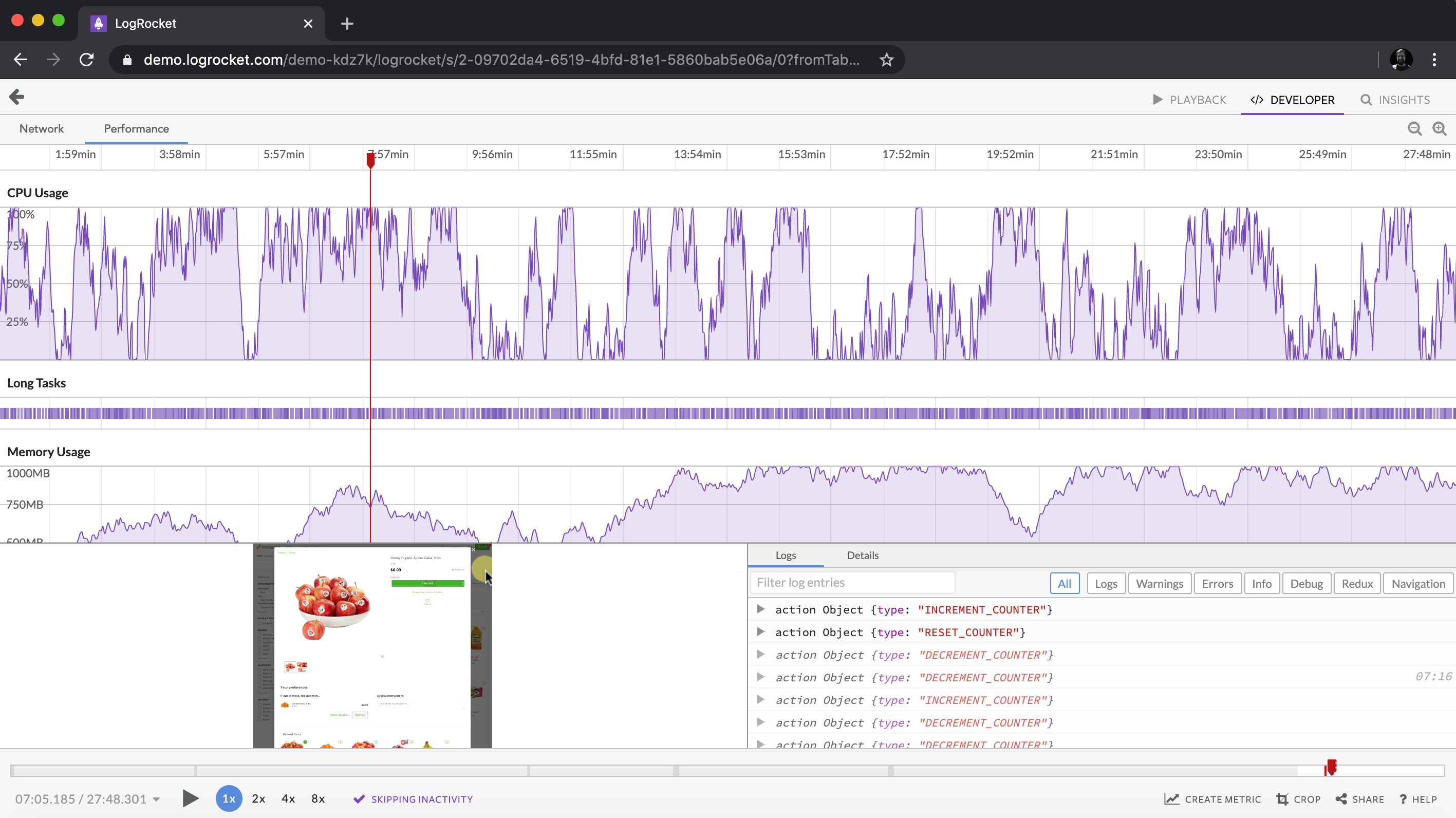
Client-side issues that impact users’ ability to activate and transact in your apps can drastically affect your bottom line. If you’re interested in monitoring UX issues, automatically surfacing JavaScript errors, and tracking slow network requests and component load time, try LogRocket.https://logrocket.com/signup/
LogRocket is like a DVR for web and mobile apps, recording everything that happens in your web app or site. Instead of guessing why problems happen, you can aggregate and report on key frontend performance metrics, replay user sessions along with application state, log network requests, and automatically surface all errors.